Solar Powered Ice Block Making Machine By Akpo Oyegwa Refrigeration Company (100)

26 September 2026

Misleading Marketing in Nigeria: The Truth About 4-Hour Ice Block Freezing Claims


Across social media in Nigeria, it is common to see advertisements for ice block making machines accompanied by videos and claims suggesting that large quantities of water can be converted into solid ice in just four hours.


These claims can be attractive to prospective buyers, particularly businesses looking for high production capacity and a fast return on investment. However, freezing water is a thermodynamic process, and the actual freezing time depends on considerably more than the size or advertised capacity of an ice block machine.


In real-world operation, freezing times can vary significantly depending on the quantity of water, starting water temperature, block size, evaporating temperature, refrigeration capacity, ambient conditions, insulation, refrigerant system, condenser performance, and the machine’s overall design.


For many conventional ice block systems, operators may experience freezing cycles measured in many hours rather than four hours. Claims of a four-hour cycle should therefore be examined carefully, particularly when the advertised cycle involves a large quantity of water and a complete conversion to solid ice.


Join our WhatsApp ChannelJoin our WhatsApp group


Why Does Freezing Take So Long?


The basic reason is simple:


A refrigeration system must remove heat from the water before the water can become ice.


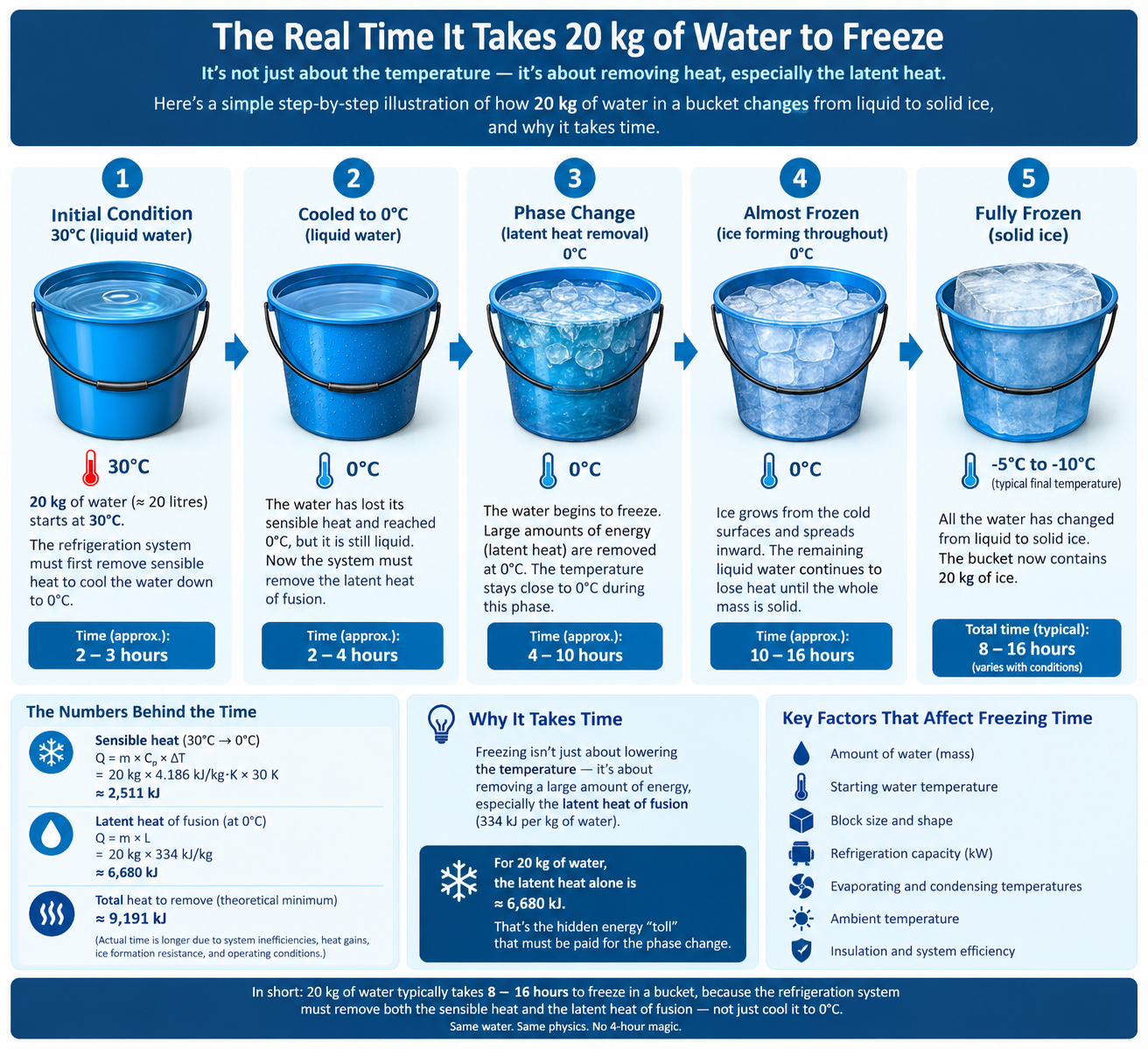
It is not enough to lower the water temperature to 0°C. A substantial amount of additional energy must be removed before the water actually changes phase from liquid water into solid ice.


This is where latent heat becomes extremely important.


What Is Latent Heat?


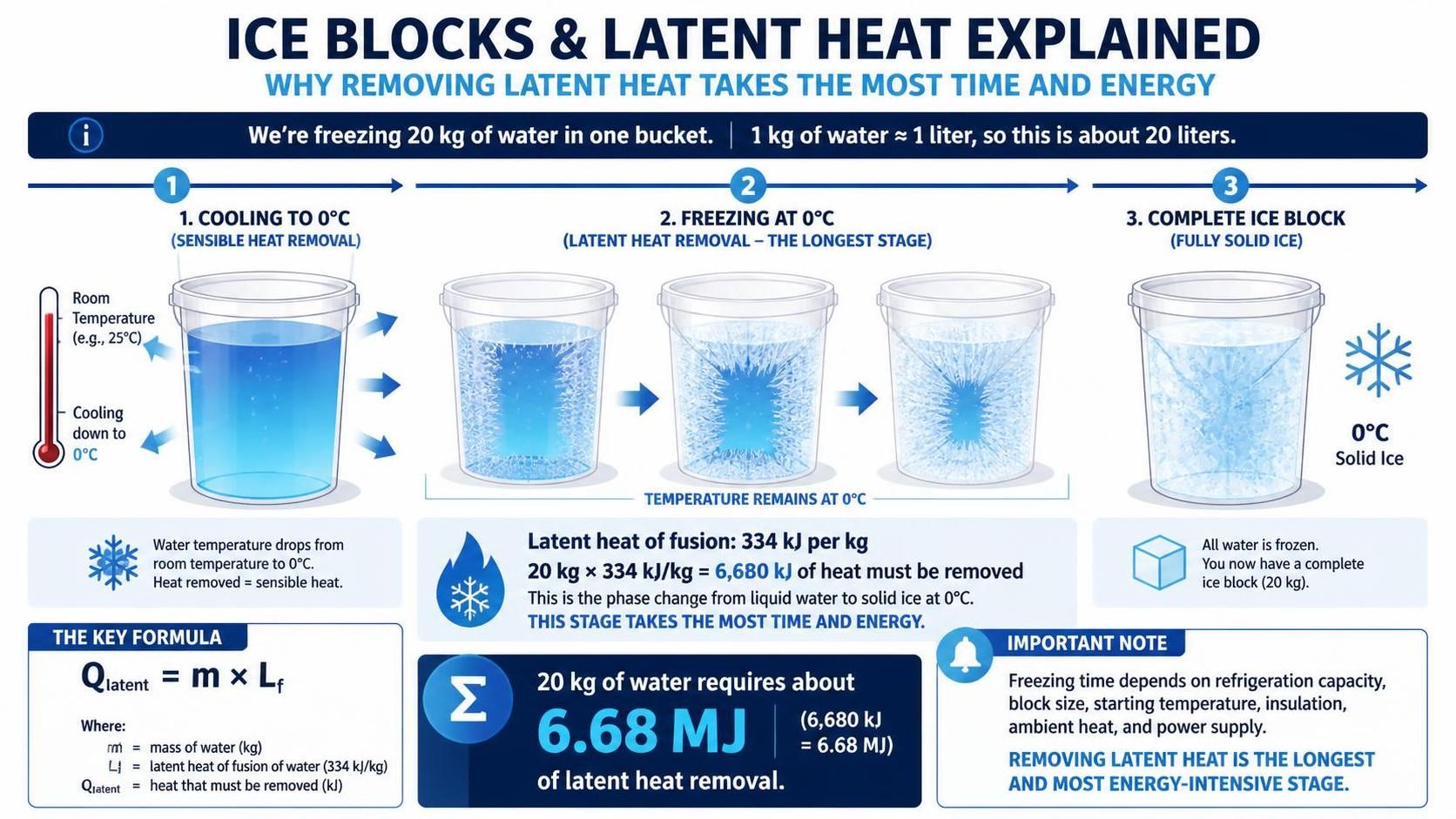
Latent heat is the energy absorbed or released by a substance during a phase change without a corresponding change in temperature.


When water freezes, the relevant property is called the latent heat of fusion.


For water, the latent heat of fusion is approximately:

334 kJ/kg

or:

334 J/g


This means that once water reaches approximately 0°C, the refrigeration system still has to remove approximately 334 kilojoules of heat for every kilogram of water to convert that water from liquid into ice at approximately 0°C.


This is the hidden energy requirement that is often overlooked when simple freezing-time claims are made.


🧊

20kg Water → Ice Latent Heat

Transparent Bucket Freezing Animation

❄️ -18°C Freezer Air
0°C
20kg / 20 Litres
⬆ Heat Leaving = Latent Heat Release
↑ ↑ ↑
00:00:00
0% frozen
Mass20 kg
Latent Heat Lf334 kJ/kg
Total Energy6680 kJ
Power Extracted250 W

Phase 2: LIQUID → SOLID at 0°C

Temperature stays at 0°C. All cooling goes into breaking H-bonds. This is latent heat plateau.

20°C0°C plateau-18°C Ice
100W Slow (18.5 hrs)250W - 7.4 hrs500W Fast (3.7 hrs)
Physics: Q = m × Lf = 20kg × 334kJ/kg = 6,680 kJ  |  Time = Q ÷ Power. At 250W → 26,720 sec = 7 hrs 25 min at 0°C plateau.

Why temperature stays at 0°C?

  • Sensible heat: 20°C → 0°C water cools quickly.
  • Latent heat: At 0°C, energy does NOT drop temperature, it rearranges molecules into crystal lattice = ice. This takes longest.
  • Transparent bucket effect: Ice forms from edges inward. Ice is less dense, you see crystals grow.


Solar Powered Ice Block Making Machine Price List.

S/N CAPACITY


Product: Solar Powered Ice Block Making Machine Total Cost: Ice Block Making Machine + Solar Power System
1 12 BLOCKS ₦5,950,000
2 20 BLOCKS ₦9,990,000
3 25 BLOCKS ₦12,970,000
4 30 BLOCKS ₦16,350,000
5 50 BLOCKS ₦36,980,000
6 100 BLOCKS ₦49,790,000
7 200 BLOCKS ₦54,670,000
8 250 BLOCKS ₦58,410,000
9 300 BLOCKS ₦63,440,000
10 400 BLOCKS ₦72,840,000
11 500 BLOCKS ₦98,920,000
12 1000 BLOCKS ₦182,400,000
13 1200 BLOCKS ₦190,920,000
14 1500 BLOCKS ₦238,880,000
15 2000 BLOCKS ₦250,900,000


Request for an official quotation.


If you are searching for:

  • Ice block making machine price list
  • Ice block making machine price list in Nigeria
  • Commercial ice block making machine price list
  • Industrial ice block making machine price list
  • Small ice block making machine price list
  • Large ice block making machine price list

you are in the right place.


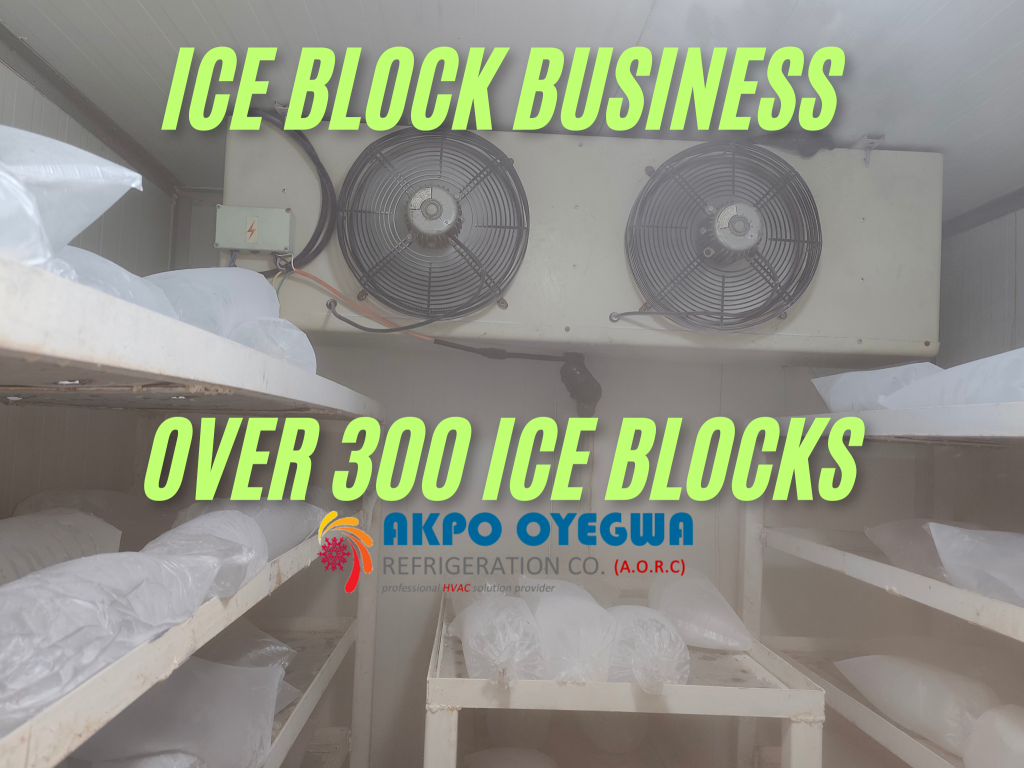
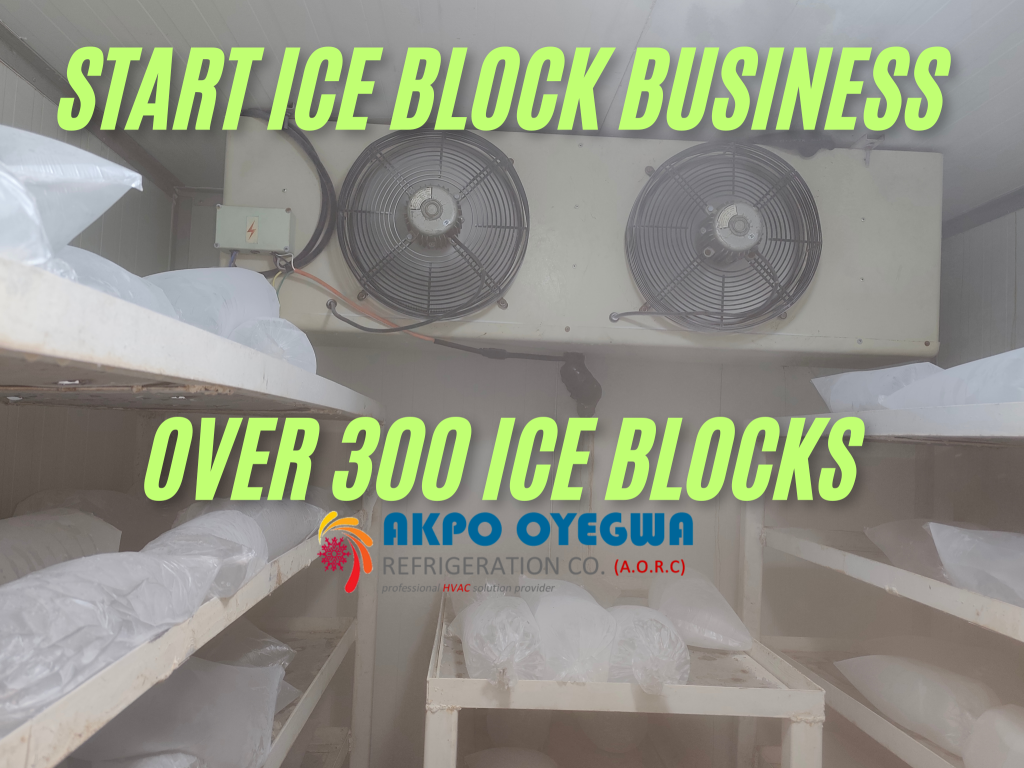
Start Ice Block Business in Nigeria. Solar ice block making machine. Cold Room. Akpo Oyegwa Refrigeration Company


Why freezing takes time.


The main reason ice does not form instantly is heat removal.


A refrigeration system does not create cold out of nothing. It removes heat from the water and transfers that heat to the surrounding environment. The larger the quantity of water, the more heat the machine must remove before the water becomes solid ice.


Water must pass through several stages:


  1. It first loses heat and cools down toward 0°C.
  2. Once it reaches approximately 0°C, it must release its latent heat of fusion.
  3. The water gradually crystallizes and becomes ice.
  4. The remaining liquid portions must continue releasing heat until the block is fully frozen.


This process takes time because the refrigeration system can remove heat only at a certain rate.


Understanding latent heat


Latent heat is the energy absorbed or released when a substance changes state without a corresponding change in temperature.


For water, the relevant energy is called the latent heat of fusion. Water must release approximately 334 joules of energy for every gram that changes from liquid to solid.


This is why water can remain at around 0°C while it is still freezing. Its temperature may not continue falling immediately because the energy being removed is being used to change the water from a liquid into a solid.


A simple way to understand the process is to imagine that freezing has an energy toll:

  • Cooling the water to 0°C is the first payment.
  • Releasing the latent heat is the second and much larger payment.
  • Only after that energy has been removed can the water become completely solid.

Until the necessary heat has been removed, some water inside the container will remain liquid.


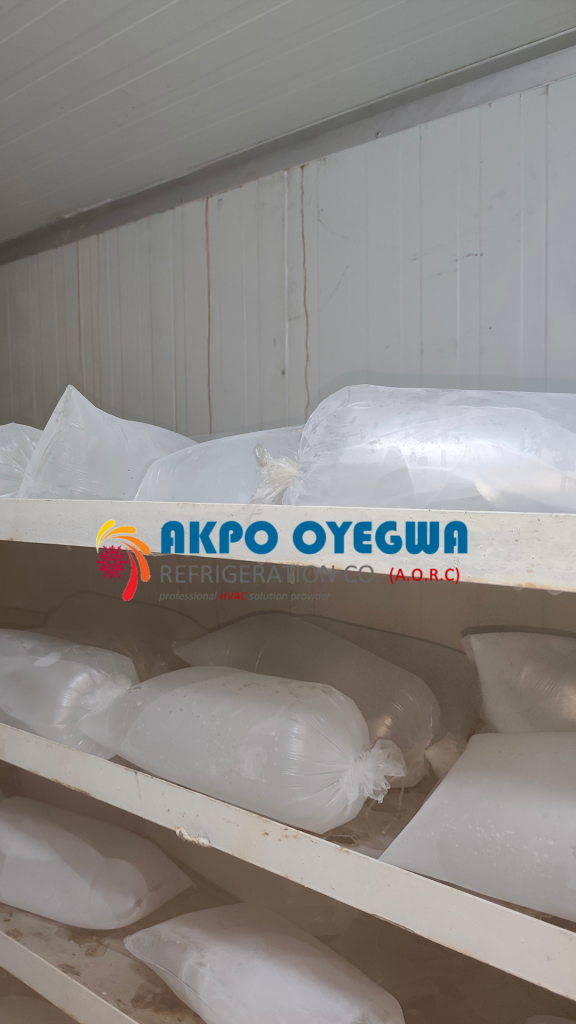
Start Ice Block Business in Nigeria. Solar ice block making machine. Cold Room. Akpo Oyegwa Refrigeration Company (1)

Why a four-hour claim may be misleading


A vendor may advertise a four-hour freezing time based on special or limited conditions, such as:


  • A small quantity of water
  • Smaller ice blocks
  • Partially frozen water
  • Very cold water loaded into the machine
  • A machine tested in a cool indoor environment
  • An unusually powerful compressor
  • Reduced production capacity
  • A demonstration showing only the first ice formation
  • A four-hour cooling period rather than complete freezing
  • A test conducted without accounting for loading, unloading, or defrost time


There is also a major difference between the formation of ice on the surface and the complete freezing of an entire block. A block may appear frozen from the outside while liquid water remains in its centre.


For commercial use, the ice must be solid enough to remove, transport, store, and sell. A partially frozen block should not be described as a fully completed production cycle.


Ice does not freeze uniformly


Water rarely freezes evenly from every direction at the same speed.


Freezing usually begins at areas closest to the coldest surfaces. Small ice crystals form at nucleation points, and those crystals gradually grow as more heat leaves the water.


In an ice block machine, the outer sections of the block may freeze first while the centre remains liquid. The thickness of the block, the distance from the cooling surface, and the circulation of heat through the water all affect the freezing rate.


This explains why large blocks generally take longer to freeze than small ones. The heat from the centre has a longer distance to travel before it can reach the cold surface and be removed by the refrigeration system.


Is it ever possible to freeze ice in four hours?


A four-hour cycle may be possible for a small quantity of water, smaller blocks, specially designed equipment, or carefully controlled conditions. However, that does not mean every machine can freeze a full commercial load in four hours.


The problem is with presenting four hours as a universal standard.


A reliable seller should clearly state:


  • The number of blocks produced per cycle
  • The size and weight of each block
  • The starting water temperature
  • The expected ambient temperature
  • The required power supply
  • Whether the time includes defrosting and harvesting
  • Whether the blocks are fully solid
  • The expected performance during hot weather
  • The recommended generator capacity
  • The machine’s warranty and technical support terms


For comparison, some commercial equipment specifications in Nigeria describe production using 8-hour, 12-hour, and 24-hour cycles rather than promising a universal four-hour result.


The business cost of believing exaggerated claims.


Buying a machine based on an unrealistic four-hour claim can create serious problems for a new ice business.


If the actual freezing cycle takes 12 or 24 hours, the buyer may experience:


  • Lower daily production than expected
  • Difficulty meeting customer demand
  • Higher fuel and electricity costs
  • Increased generator usage
  • Longer waiting times between production cycles
  • Cash-flow problems
  • Premature equipment failure from overworking the machine
  • Disputes with customers or suppliers


A machine that genuinely produces fewer blocks over a longer cycle may still be profitable if its energy consumption, maintenance costs, selling price, and daily output are properly calculated.


The key is to buy equipment based on realistic production figures rather than an attractive video demonstration.


Solar Powered Ice Block Making Machine By Akpo Oyegwa Refrigeration Company (95)


A more honest way to advertise ice block machines.

A more accurate claim would explain the operating conditions:


The four-hour ice block machine claim commonly seen on social media should be treated carefully. While certain machines may freeze small quantities or specially sized blocks within four hours, that result should not automatically be applied to full commercial loads.


Freezing takes time because the machine must first cool the water to approximately 0°C and then remove the substantial latent heat required for the water to change from liquid into solid ice. Water also freezes progressively, with ice forming near cold surfaces before the centre becomes fully solid.


For many standard commercial ice block machines, realistic freezing cycles may fall within the 8-to-24-hour range, depending on capacity and operating conditions. Buyers should therefore focus on verified output, block size, energy consumption, power requirements, and complete-cycle performance not just a fast number used in a promotional video.


The best ice block machine is not necessarily the one promising the shortest freezing time. It is the one that delivers consistent, fully frozen blocks at a production rate and operating cost that suit your business.


Look Beyond the 4-Hour Claim


The claim that an ice block machine can freeze a large quantity of water in four hours should not be accepted simply because it appears in a social media advertisement.


Freezing is an energy-removal process.


For every kilogram of water, approximately 334 kJ of latent heat must be removed during the liquid-to-solid phase change, in addition to the sensible heat that must be removed to cool the water to its freezing point.


Actual freezing time is therefore determined by the interaction between the mass of water, starting temperature, block dimensions, heat-transfer characteristics, refrigeration capacity, operating temperatures, ambient conditions and system efficiency.


For this reason, buyers should evaluate ice block machines using measurable refrigeration and production data rather than relying solely on promotional videos or headline claims such as “4-hour freezing.”


A technically credible supplier should be able to explain how much water the machine freezes, under what conditions, with what refrigeration capacity, and how the stated freezing time was determined.


Why Water Quantity Matters


The greater the mass of water being frozen, the greater the amount of heat that must be removed.


For example, ignoring heat losses and other practical factors, doubling the amount of water approximately doubles the total energy that must be removed.


Request Your Ice Block Making Machine Quotation Today


Whether you are planning your first ice production business or expanding an existing operation, Akpo Oyegwa Refrigeration Company is ready to help you achieve long-term success with reliable, energy-efficient, and professionally engineered refrigeration systems.

Take the Next Step

✔ View our latest Ice Block Making Machine Price List

✔ Fill out our Quotation Request Form to receive a customized proposal.

✔ Follow our social media pages for installation projects, customer success stories, maintenance tips, and new product updates.


Our experienced engineers will help you select the ideal machine based on your production capacity, available space, power supply, and investment budget.


Invest in quality equipment today and position your business for years of reliable ice production, lower operating costs, and increased profitability.

 

Akpo Oyegwa Refrigeration Company: Delivering dependable commercial and industrial refrigeration solutions across Nigeria.


Go To Top