Refrigerants Worldwide: Which Are Prohibited, Being Phased Out and Still Accepted?
Refrigerants are essential to refrigeration, air conditioning, cold storage, food preservation, pharmaceutical storage, industrial cooling and heat-pump systems. However, not all refrigerants have the same environmental impact or regulatory status.
Over the past several decades, the refrigeration industry has moved away from refrigerants that damage the ozone layer and is now increasingly moving away from refrigerants with high global warming potential (GWP).
The Montreal Protocol and its amendments have been central to this transition. Chlorofluorocarbons (CFCs) were phased out because of their ozone-depleting properties, while hydrochlorofluorocarbons (HCFCs) are being phased out. Hydrofluorocarbons (HFCs), although they do not deplete the ozone layer, are being phased down because many have high global warming potential.
For businesses purchasing refrigeration or air-conditioning equipment, therefore, it is important to understand whether a refrigerant is:
Globally prohibited or essentially phased out;
Being phased out or phased down;
Still permitted but increasingly restricted;
Or considered a lower-GWP alternative for modern equipment.
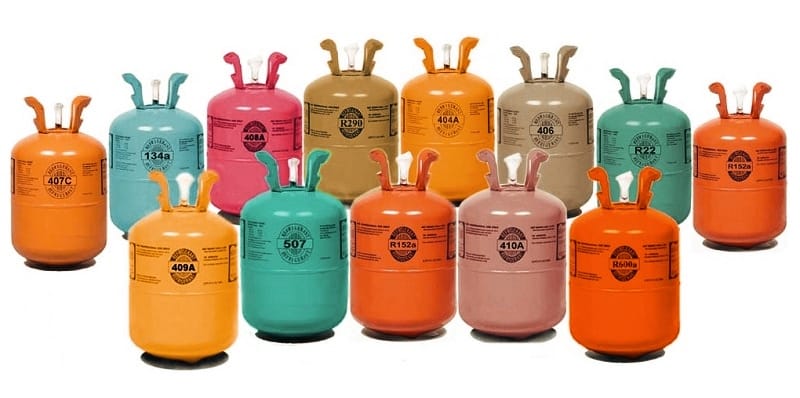
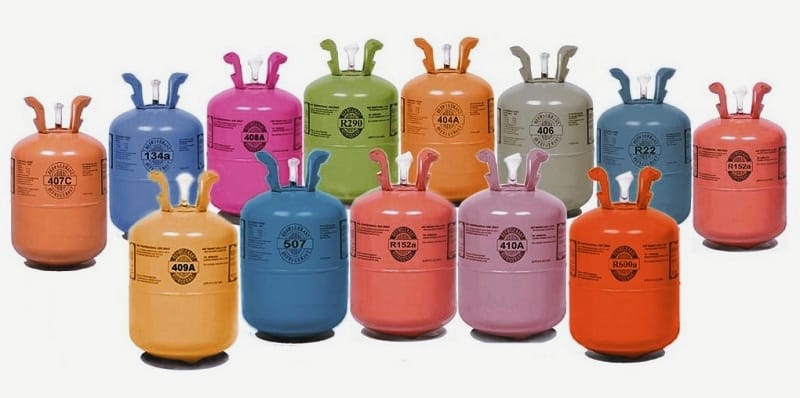
Refrigerant Gases for Sale – R-22, R-134a, R-410A and More – Competitive Prices and Expert Support
1. Why Are Refrigerants Being Prohibited or Phased Out?
There are two major environmental concerns associated with refrigerants:
Ozone depletion
Some older refrigerants contain chlorine or bromine that can contribute to the destruction of stratospheric ozone.
CFCs were particularly damaging to the ozone layer. HCFCs were subsequently used as transitional alternatives because they have lower ozone-depletion potential than CFCs, but they still damage the ozone layer.
This led to the international phase-out of CFCs and the ongoing phase-out of HCFCs under the Montreal Protocol.
Global warming
Many newer refrigerants were developed as replacements for CFCs and HCFCs. HFCs do not deplete the ozone layer, but several HFC refrigerants have very high GWP.
For example, R-404A has a much higher climate impact than low-GWP alternatives such as carbon dioxide, ammonia and hydrocarbons.
The Kigali Amendment therefore established a global framework for reducing HFC consumption and encouraging the adoption of lower-GWP technologies.
2. Refrigerants That Have Been Globally Phased Out or Prohibited
It is important to use the term “globally phased out” carefully. International agreements establish global obligations, but national laws determine exactly how those obligations are implemented. Some historical substances may also have narrowly defined essential-use or other exemptions.
CFC Refrigerants
The best-known examples include:
Refrigerant
Chemical family
Typical historical application
Current status
R-11
CFC
Large chillers and foam blowing
Phased out
R-12
CFC
Refrigerators, freezers and automotive AC
Phased out
R-13
CFC
Low-temperature refrigeration
Phased out
R-113
CFC
Refrigeration/industrial applications
Phased out
R-114
CFC
Specialized refrigeration
Phased out
R-115
CFC
Component of R-502
Phased out
CFCs are controlled substances under the Montreal Protocol because of their ozone-depleting properties.
R-12
R-12 (dichlorodifluoromethane) was historically widely used in domestic refrigerators, freezers and vehicle air-conditioning systems.
It has since been replaced by alternatives including R-134a and, increasingly, lower-GWP alternatives depending on the application.
R-11
R-11 was widely used in large centrifugal chillers and other applications.
Modern systems use alternatives with substantially lower environmental impact.
Important distinction
The phase-out of CFCs does not mean that every old piece of equipment containing a CFC automatically has to be destroyed. Existing equipment and recovered refrigerant can be subject to specific national rules concerning recovery, recycling, reclamation and disposal.
Releasing old refrigerant into the atmosphere is not an acceptable servicing practice.
3. HCFC Refrigerants: Being Phased Out
Hydrochlorofluorocarbons (HCFCs) were introduced as transitional refrigerants after CFCs.
The most familiar example is:
R-22
R-22 (HCFC-22) has historically been one of the most widely used refrigerants for:
Air-conditioning systems
Cold rooms
Freezers
Commercial refrigeration
Industrial refrigeration
Heat pumps
However, R-22 is an ozone-depleting substance and is being phased out under the Montreal Protocol.
For developing countries operating under Article 5 of the Montreal Protocol, the international schedule requires complete HCFC phase-out by 2030, subject to the Protocol’s specific provisions and exemptions.
This means that R-22 should not be considered a long-term refrigerant for new refrigeration installations.
R-123
R-123 is another HCFC historically used particularly in centrifugal chillers.
It is also subject to the HCFC phase-out.
What does this mean for an existing R-22 system?
An existing R-22 refrigeration or air-conditioning system may continue to operate where national regulations permit it. However, businesses should consider the long-term availability and regulatory direction of the refrigerant before investing heavily in an old R-22 system.
For a new installation, selecting a refrigerant that aligns with the long-term regulatory direction is generally a better approach.
4. HFC Refrigerants: Not Ozone-Depleting, But Being Phased Down
This is where there is often considerable confusion.
HFC refrigerants are not the same as CFCs and HCFCs.
They do not deplete the ozone layer, but many HFCs have high GWP.
The Kigali Amendment therefore established a global phase-down, rather than a blanket worldwide prohibition of every HFC refrigerant. The exact reduction schedule differs between groups of countries.
Some important HFC refrigerants include:
Refrigerant
Common application
General direction
R-134a
Refrigeration, chillers, automotive AC
Increasingly restricted in some markets
R-404A
Commercial and industrial refrigeration
Strongly being replaced
R-507A
Low-temperature refrigeration
Being replaced
R-407C
Air conditioning
Increasing restrictions in some markets
R-410A
Air conditioning/heat pumps
Transitioning to lower-GWP alternatives in many markets
R-32
Air conditioning/heat pumps
Lower-GWP HFC, but still subject to HFC phase-down
The important point is that HFC phase-down does not mean every HFC is currently illegal worldwide.
5. R-404A: A Refrigerant Increasingly Being Replaced
R-404A became extremely popular in commercial refrigeration, cold rooms, freezers and low-temperature applications.
However, its GWP is very high compared with modern alternatives.
Consequently, many markets are moving away from R-404A.
Potential alternatives depend on the equipment and application and can include:
R-744 (CO₂)
R-717 (ammonia)
R-290 (propane)
R-449A
Other lower-GWP refrigerant blends
UNEP identifies ammonia, carbon dioxide, hydrocarbons, HFOs and lower-GWP HFC blends among the major alternative refrigerant technologies being adopted as HCFCs and high-GWP refrigerants are transitioned out.
6. R-410A: Still Used, But No Longer the Final Destination
R-410A has been widely used in split air conditioners, heat pumps and other air-conditioning equipment.
It does not deplete the ozone layer, but its GWP is significantly higher than that of newer alternatives.
As regulations increasingly target high-GWP refrigerants, manufacturers in many markets are transitioning toward refrigerants such as:
R-32
R-454B
Other lower-GWP refrigerant technologies
The appropriate replacement depends on equipment design, operating pressure, safety classification, efficiency and applicable regulations.
7. Refrigerants That Are Widely Accepted for Modern Applications
There is no single refrigerant that is “fully accepted worldwide” for every application.
A refrigerant can be environmentally favourable but still be unsuitable for a particular machine because of:
Flammability
Toxicity
Operating pressure
Temperature range
Compressor compatibility
Equipment design
Local regulations
Maximum refrigerant charge
Required safety systems
Nevertheless, several low-GWP refrigerants are widely recognised as important long-term alternatives.
R-717 — Ammonia
R-717 (ammonia) has a GWP of approximately zero and has been used in industrial refrigeration for many decades.
It is particularly suitable for applications such as:
Industrial cold storage
Food processing
Large cold rooms
Blast freezing
Ice production
Large industrial refrigeration systems
Ammonia is highly efficient, but it is toxic and requires properly designed systems and trained personnel.
R-744 — Carbon Dioxide (CO₂)
R-744 (carbon dioxide) has a GWP of 1 under the conventional 100-year GWP reference used for refrigerants.
CO₂ is increasingly used in:
Commercial refrigeration
Supermarkets
Cold storage
Industrial refrigeration
Heat pumps
Transport refrigeration applications
Its major advantage is extremely low environmental impact compared with high-GWP synthetic refrigerants.
However, CO₂ systems operate at relatively high pressures and must be designed specifically for CO₂ operation.
R-290 — Propane
R-290 (propane) is a hydrocarbon refrigerant with extremely low GWP.
It is used in applications including:
Commercial refrigeration
Refrigerated display equipment
Chillers
Heat pumps
Some air-conditioning equipment
Its principal challenge is flammability. R-290 is classified as A3, meaning it is highly flammable, so equipment must be designed and installed according to applicable safety requirements.
The European Commission identifies R-290, R-717 and R-744 among climate-friendly refrigerant alternatives.
R-32
R-32 is an HFC refrigerant with a substantially lower GWP than R-410A.
It is widely used in modern air-conditioning and heat-pump equipment.
However, R-32 is still an HFC and therefore remains within the broader global HFC phase-down framework. It should therefore not be described as a completely regulation-free refrigerant.
R-32 is classified as A2L, meaning it has lower flammability.
HFO Refrigerants
Hydrofluoroolefins (HFOs), such as R-1234yf and R-1234ze(E), were developed as very-low-GWP alternatives for certain applications.
They are used in various refrigeration, air-conditioning, automotive and industrial applications.
The European Commission lists HFOs and low-GWP HFO/HFC blends among the alternative technologies being used to reduce the climate impact of refrigeration and air-conditioning.
8. A Simple Classification of Major Refrigerants
The refrigeration industry can broadly be understood as follows:
Category 1 — Phased out ozone-depleting refrigerants
Examples:
R-11
R-12
R-113
R-114
R-115
These are CFC refrigerants and have been phased out under the international ozone-protection regime.
Category 2 — Being phased out
Examples:
R-22
R-123
Other HCFC refrigerants
HCFCs are being eliminated because they deplete the ozone layer.
Category 3 — Being phased down because of high GWP
Examples include:
R-404A
R-507A
R-410A
R-134a
Certain other high-GWP HFCs
The exact regulatory restrictions depend on the refrigerant, application and country.
Category 4 — Lower-GWP alternatives
Examples include:
R-717 — Ammonia
R-744 — CO₂
R-290 — Propane
R-32
HFO refrigerants
Selected low-GWP refrigerant blends
These refrigerants are important in the industry’s transition toward lower environmental impact.
9. Are Any Refrigerants “Fully Accepted Worldwide”?
There is an important misconception that there is a universal list of refrigerants that are completely unrestricted everywhere in the world.
There is no such universal list.
A refrigerant can be internationally recognised as an environmentally preferable option while still being subject to national, regional, equipment-specific or safety regulations.
For example:
Ammonia has excellent environmental characteristics but is toxic.
Propane has very low GWP but is highly flammable.
CO₂ has very low climate impact but operates at high pressures.
R-32 has lower GWP than R-410A but is mildly flammable.
HFOs can have very low GWP but may have application-specific requirements.
UNEP specifically notes that refrigerant alternatives must be evaluated according to performance, cost, availability, toxicity, flammability, operating pressure, GWP and energy efficiency.
Therefore, the correct question is not simply:
“Which refrigerant is legal worldwide?”
A better question is:
“Which refrigerant is technically suitable, safe, commercially available and compliant with the regulations applicable to this particular project?”
10. Why Refrigerant Selection Matters When Building a New Cold Room
When constructing a new cold room, freezer, blast freezer, cold warehouse or industrial refrigeration system, refrigerant selection should be considered at the design stage.
The refrigerant affects:
Compressor selection
Condensing unit specification
Evaporator design
Condenser design
Operating pressure
Energy consumption
Pipe sizing
Safety requirements
Maintenance procedures
Refrigerant availability
Future servicing costs
Regulatory compliance
For this reason, simply selecting a refrigerant because it is currently cheap or readily available may not be the best long-term decision.
A refrigeration system can remain in service for many years. Selecting a refrigerant with a favourable long-term regulatory outlook can reduce the risk of future servicing and refrigerant-availability problems.
11. Refrigerant Regulations Are Becoming Increasingly Important
The regulatory transition is not occurring at the same speed everywhere.
Under the Montreal Protocol, developing countries are progressing through the HCFC phase-out, while the Kigali Amendment establishes HFC phase-down schedules. For Article 5 Group 1 countries, for example, the HFC freeze began in 2024, followed by a 10% reduction in 2029 and progressively larger reductions thereafter.
Regulations in individual markets can be considerably stricter.
For example, the European Union’s F-gas Regulation has introduced restrictions on high-GWP fluorinated gases in refrigeration and air-conditioning equipment. The EU rules include restrictions on servicing equipment with F-gases above specified GWP thresholds and additional restrictions on placing certain refrigeration equipment on the market.
This demonstrates why an international refrigerant transition should not be interpreted as meaning that every country has exactly the same prohibition date.
12. What Should Businesses in Nigeria Consider?
Businesses planning to install:
Cold rooms
Walk-in freezers
Blast freezers
Cold warehouses
Ice-making machines
Industrial refrigeration systems
Commercial refrigeration
Air-conditioning systems
Refrigerated containers
should consider the entire life cycle of the refrigeration equipment, rather than only its initial purchase price.
A suitable refrigerant should ideally provide:
Good energy efficiency;
Appropriate operating characteristics;
Availability of qualified technicians;
Availability of refrigerant and spare parts;
Appropriate safety characteristics;
Acceptable environmental impact;
Compliance with applicable Nigerian and international requirements;
Good long-term serviceability.
For large industrial refrigeration projects, refrigerant selection should be part of the engineering design rather than an afterthought.
Order Refrigerant Gases – R-22, R-134a, R-410A and More – Competitive Prices and Expert Support
Conclusion
The refrigeration industry is undergoing a major transition.
CFC refrigerants such as R-11 and R-12 have been phased out because they damage the ozone layer. HCFC refrigerants such as R-22 are also being phased out. High-GWP HFC refrigerants are not universally prohibited, but their consumption is being reduced under the Kigali Amendment and many jurisdictions are introducing additional restrictions.
At the same time, refrigerants such as ammonia (R-717), carbon dioxide (R-744), propane (R-290), R-32, HFOs and selected low-GWP blends are playing increasingly important roles in modern refrigeration and air-conditioning technology.
There is therefore no single refrigerant that should simply be labelled “the world’s fully accepted refrigerant.” The correct choice depends on the application, equipment design, safety requirements, environmental characteristics, technical requirements and regulations applicable in the country where the equipment will operate.
For a new refrigeration installation, the objective should be to select a technically suitable, safe, energy-efficient and future-oriented refrigerant rather than simply choosing the refrigerant that is most familiar or cheapest today.
Akpo Oyegwa Refrigeration Company provides refrigeration engineering and cooling solutions for commercial and industrial applications, including cold rooms, blast freezers, cold storage systems and refrigeration equipment. Refrigerant selection should always be based on the specific system design and application requirements.
Disclaimer: Refrigerant regulations change over time and may differ between countries and applications. This article provides general technical information and should not be treated as a substitute for checking the current regulations applicable to a specific project.
Don’t let your HVAC or refrigeration systems suffer without the right refrigerant gas. Order now from Akpo Oyegwa Refrigeration Company and ensure that your systems are running at peak performance.