Ton vs Tonne in Cold Storage: What Is the Difference?
When discussing cold storage capacity, terms such as ton, tonne, metric ton, storage tonnage and refrigeration ton are sometimes used interchangeably. However, they do not always mean the same thing.
Understanding the difference is important when designing, purchasing, quoting or evaluating a cold room, freezer room, pharmaceutical cold storage facility, blast freezer or refrigerated warehouse.
For example, a statement such as “this cold room has a capacity of 10 tons” can be ambiguous. Does it mean the room can physically store 10 tonnes of products? Or does it refer to 10 tons of refrigeration capacity?
This article explains the difference in simple terms.
What Is a Tonne?
A tonne is a metric unit of mass.
1 tonne = 1,000 kilograms
Therefore:
- 1 tonne = 1,000 kg
- 2 tonnes = 2,000 kg
- 5 tonnes = 5,000 kg
- 10 tonnes = 10,000 kg
- 20 tonnes = 20,000 kg
The tonne is commonly used in countries that use the metric system, including Nigeria.
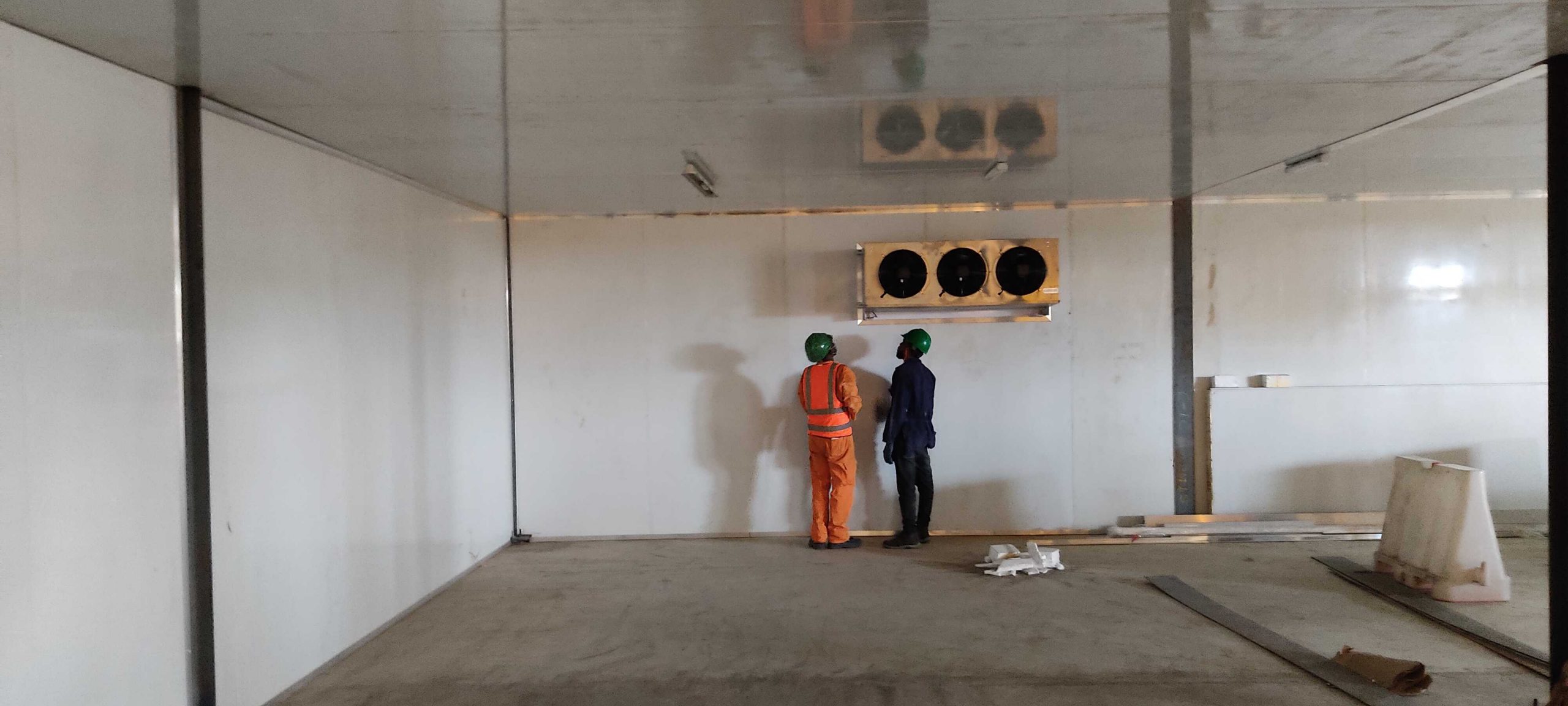
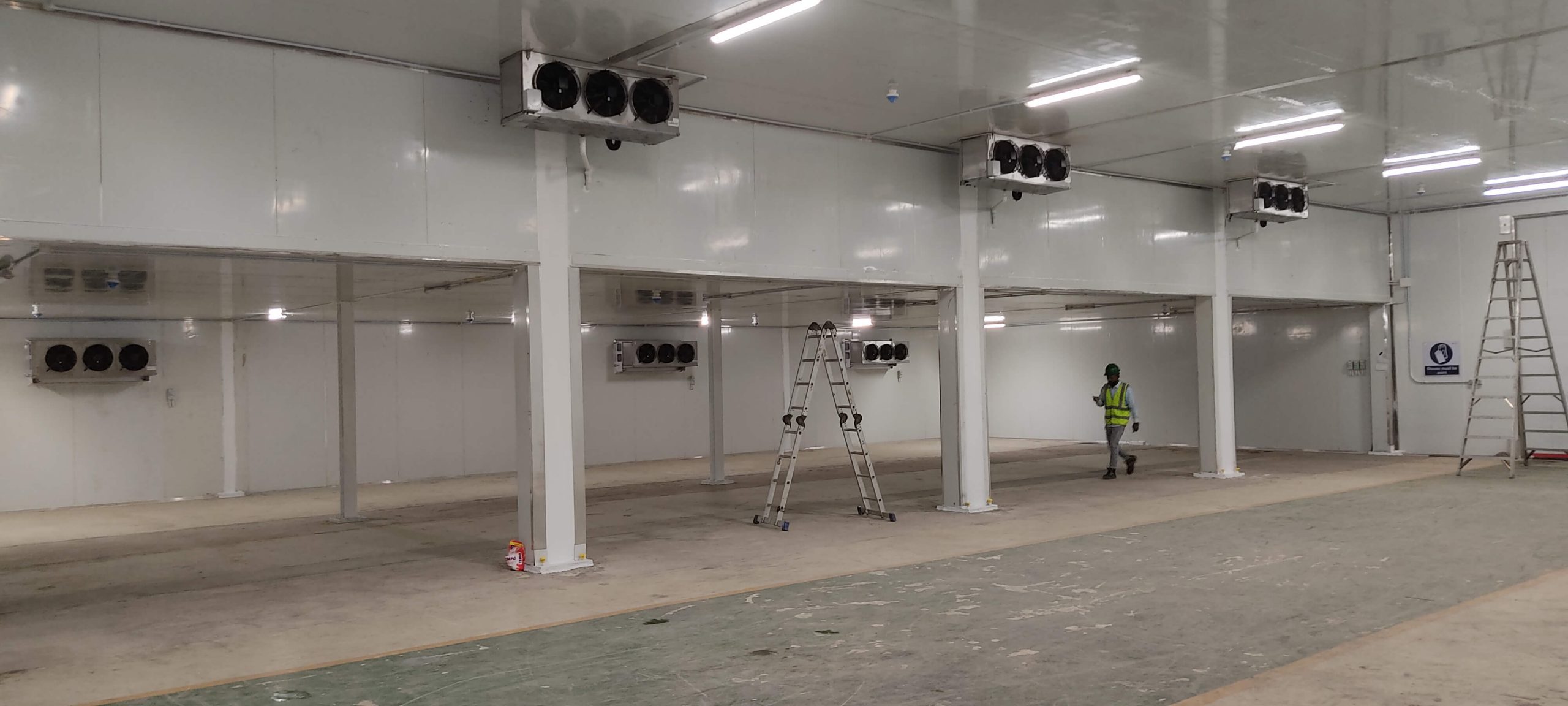
Visual Illustration 1

Join our WhatsApp ChannelJoin our WhatsApp group
In a cold-storage project, when a client says that a cold room should store 10 tonnes of chicken, this normally means approximately:
10 × 1,000 kg = 10,000 kg of chicken.
However, the actual amount that can be placed inside the room depends on how the products are packaged and arranged.
What Is a Ton?
The word ton is not a single universal unit.
Depending on the country and industry, “ton” can refer to different measurements.
The three commonly encountered definitions are:
| Type |
Equivalent in kilograms |
| Metric tonne |
1,000 kg |
| US short ton |
907.18 kg |
| UK long ton |
1,016.05 kg |
This means that saying simply “10 tons” without specifying the type of ton can create ambiguity.
Ton vs Tonne at a Glance
Visual Illustration 2
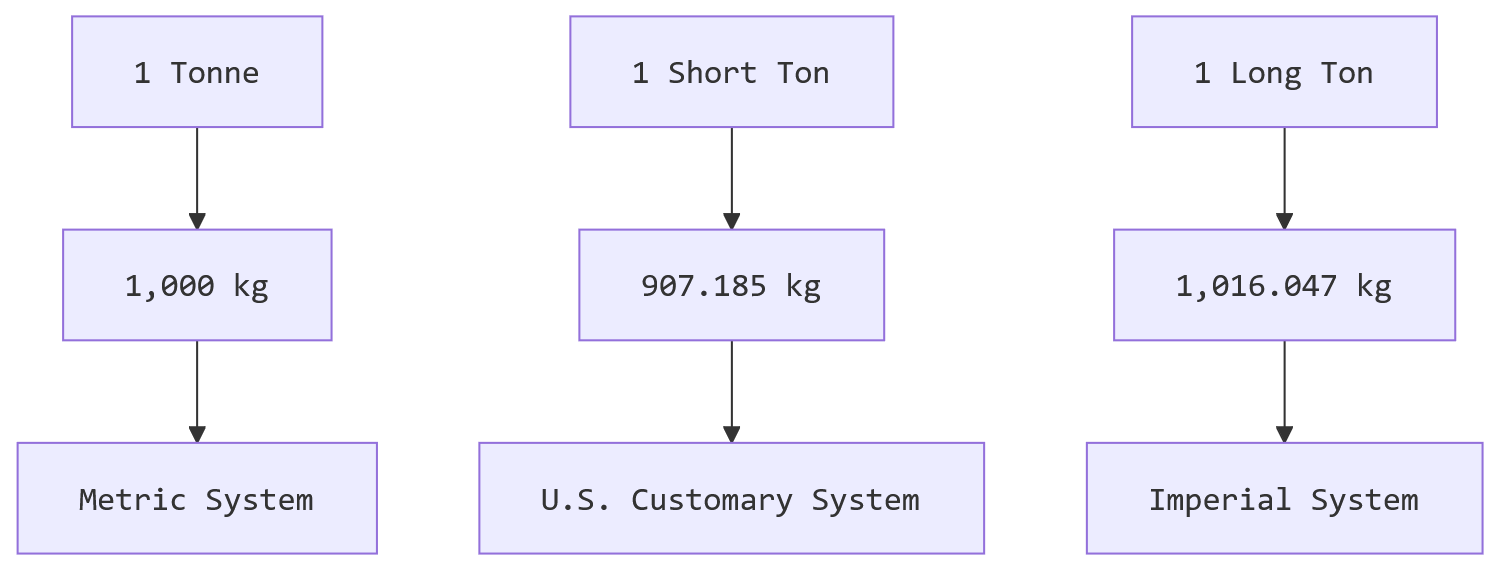
The difference may appear small for one unit, but it becomes significant when dealing with large commercial cold-storage facilities.
For example, 100 US short tons would represent approximately 90,718 kg, whereas 100 metric tonnes represents 100,000 kg.
That is a difference of approximately 9,282 kg.
Ton vs Tonne: Which One Should Be Used for Cold Storage in Nigeria?
For cold-storage projects in Nigeria, tonnes (metric tonnes) are generally the clearer unit when describing the mass of products to be stored.
For example, instead of saying:
“We need a 20-ton cold room.”
It is clearer to say:
“We need a cold room capable of storing approximately 20 metric tonnes of frozen chicken.”
This removes uncertainty about the intended measurement.
Even better, the specification should state both the physical dimensions and the target product capacity.
For example:
Cold room: 6 m × 5 m × 3 m internal dimensions
Temperature: -18°C
Product: Frozen chicken
Target storage capacity: Approximately 20 tonnes
Storage arrangement: Palletised
This provides considerably more useful information to the refrigeration designer.
Important: Cold Storage Capacity Is Not the Same as Refrigeration Capacity
One of the most important distinctions in refrigeration is the difference between:
Product storage capacity
and
Refrigeration capacity
These are two completely different things.
A cold room may be described as having a 20-tonne storage capacity, while its refrigeration system may have a cooling capacity specified in kW or TR (tons of refrigeration).
These two “tons” should not be confused.
Visual Illustration 3

These values cannot be directly substituted for each other.
A 100-tonne cold room does NOT automatically require 100 tons of refrigeration.
What Is a Ton of Refrigeration?
A ton of refrigeration (TR) is a unit of cooling capacity.
It does not represent the weight of products inside a cold room.
One refrigeration ton is approximately:
1 TR = 3.517 kW of cooling capacity
Therefore:
| Refrigeration Capacity |
Approximate Cooling Capacity |
| 1 TR |
3.517 kW |
| 2 TR |
7.034 kW |
| 5 TR |
17.585 kW |
| 10 TR |
35.17 kW |
| 20 TR |
70.34 kW |
The refrigeration capacity required for a cold room is determined through a heat-load calculation, not simply by multiplying the product storage capacity by a fixed number.
Visual Illustration 4: Storage Tonnes vs Refrigeration Tons
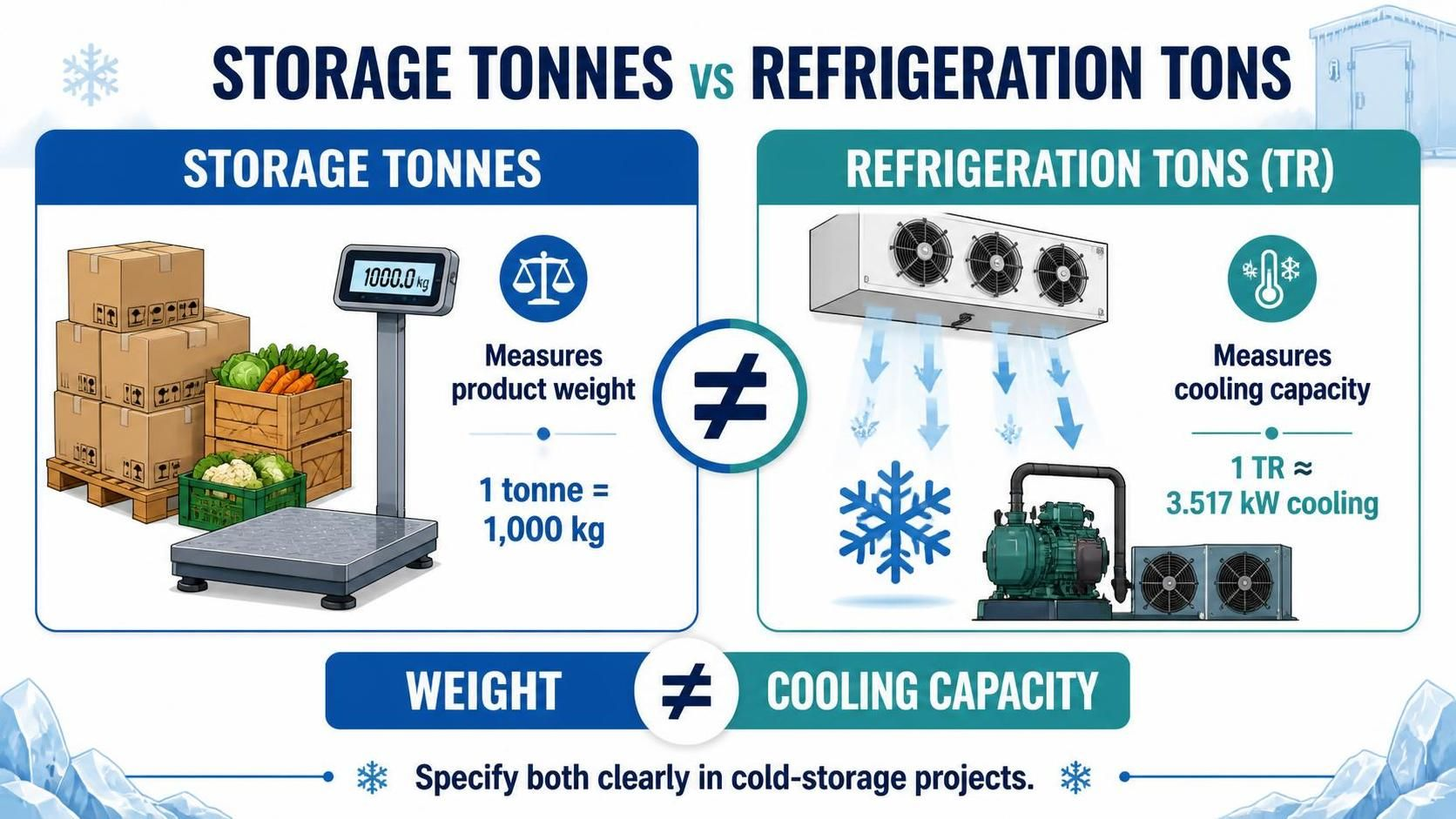
The 1 tonnes refers to the mass of products.
The 1 TR refers to the refrigeration system’s cooling capacity.
They answer different questions.
How Does a Cold Room’s Tonne Capacity Get Determined?
A cold room’s product capacity cannot always be determined from its external dimensions alone.
Several factors affect the actual amount of product that can be stored.
These include:
- Internal room dimensions
- Product dimensions
- Product weight
- Packaging
- Pallet dimensions
- Shelving/racking
- Required aisles
- Door clearance
- Evaporator clearance
- Air circulation requirements
- Stacking height
- Product handling method
- Required loading and unloading space
For example, two cold rooms with exactly the same internal volume may have significantly different practical storage capacities.
Volume Does Not Equal Product Capacity
Suppose a cold room has an internal volume of:
100 m³
It would be incorrect to automatically conclude that it can store exactly 100 tonnes of products.
Why?
Because:
1 m³ of cold-room space does not automatically equal 1 tonne of product.
Products have different densities, shapes and packaging.
In addition, not every cubic metre inside a cold room can be occupied by products.
Space must be allowed for:
- Air circulation
- Access
- Pallets
- Shelving
- Product handling
- Evaporator clearance
- Door operation
- Safety and operational requirements
Visual Illustration 5: Why the Entire Cold Room Cannot Be Filled
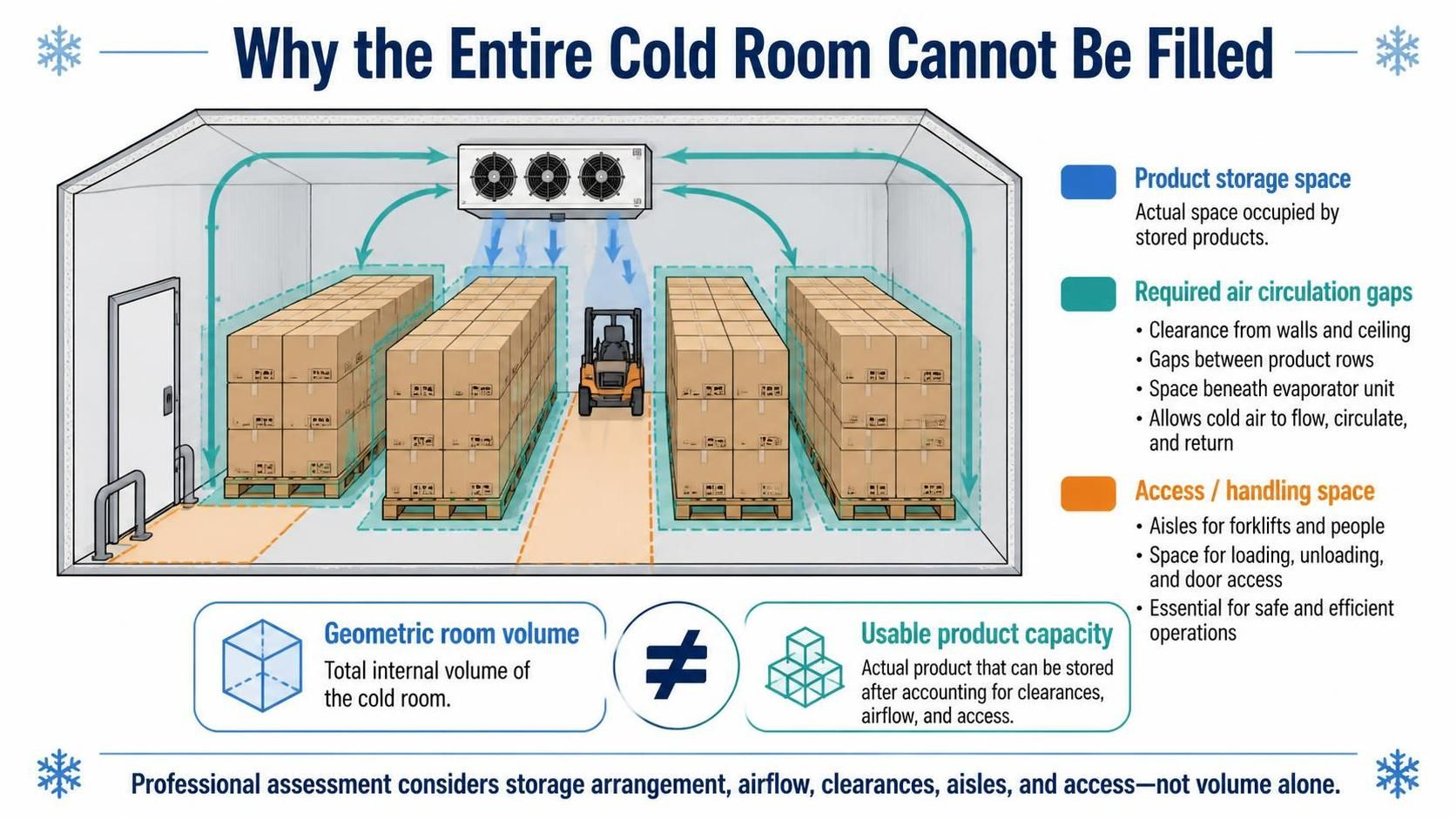
Not every cubic metre becomes product storage.
This is why a professional cold-storage capacity assessment should consider the actual storage arrangement, rather than simply calculating the room’s geometric volume.
Product Density Also Matters
Different products have different densities.
For example, a cubic metre of one product may weigh substantially more or less than a cubic metre of another product.
Packaging also affects the usable storage volume.
Consider two products stored in identical rooms:
Cold Room A
Frozen chicken packed in cartons.
Cold Room B
Large crates of vegetables.
Even if both rooms have the same internal volume, their practical storage capacity in tonnes may be different.
Pallets and Shelving Can Change Storage Capacity
The method of storage can significantly affect how much product can be stored.
Common arrangements include:
- Products stacked directly on the floor
- Palletised storage
- Shelving
- Racking
- Plastic crates
- Wire racks
- Mobile shelving
- High-density pallet racking
Visual Illustration 6: Different Storage Arrangements
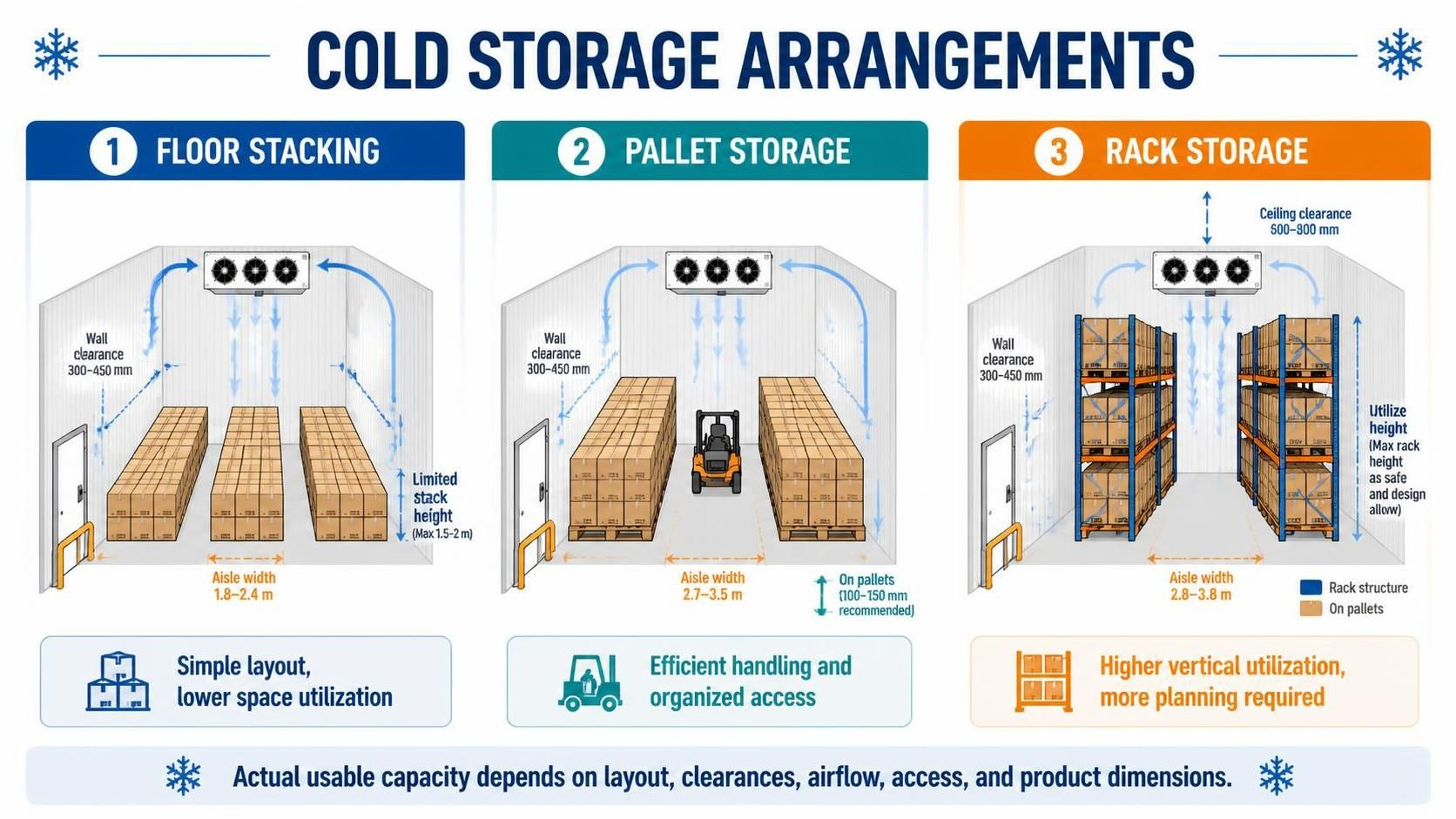
The same cold-room dimensions can therefore produce different usable product capacities depending on the storage system.
Why Cold-Room Quotations Should Specify “Tonnes”
When requesting a quotation for a cold-storage project, it is advisable to provide specific information rather than simply saying:
“I need a 10-ton cold room.”
A better request would be:
Product: Frozen chicken
Required storage: 10 metric tonnes
Storage temperature: -18°C
Room dimensions: 5 m × 4 m × 3 m, if already determined
Packaging: 10 kg cartons
Storage arrangement: Pallets
Loading frequency: Daily
Product entering room: Frozen / chilled
Desired operating conditions: As specified by the application
This allows the refrigeration contractor or engineer to assess the project more accurately.
What Information Is Needed to Determine Refrigeration Capacity?
The refrigeration system should normally be selected after assessing the expected heat load.
Important factors include:
1. Room dimensions
Length × width × height determine the internal volume and surface area.
2. Insulation
Panel thickness and insulation properties influence heat transfer through the walls, ceiling and floor.
3. Ambient temperature
The outdoor temperature affects heat entering the cold room and the condenser operating conditions.
4. Product temperature
A product entering at +5°C requires a different refrigeration load from one entering at +30°C.
5. Product quantity
The quantity of product entering the room affects the product load.
6. Product pull-down/freezing requirement
A freezer used to freeze warm products requires substantially different refrigeration capacity from a freezer storing products that have already been frozen.
7. Door openings
Frequent door opening introduces warm and humid air.
8. People and lighting
Personnel, lights and electrical equipment inside the room generate heat.
9. Fans and motors
Evaporator fans and other equipment contribute heat to the room.
10. Required temperature
A room maintained at +2°C to +8°C has different requirements from a freezer maintained at -18°C or below.
A Simple Example
Suppose a client wants a cold room for:
20 tonnes of frozen chicken
The statement “20 tonnes” describes the desired product storage mass.
It does not tell the refrigeration engineer exactly how large the refrigeration system must be.
The engineer still needs to know:
- Cold-room dimensions
- Insulation thickness
- Product entry temperature
- Desired room temperature
- Product loading rate
- Ambient temperature
- Door opening frequency
- Storage arrangement
- Required pull-down time
- Lighting and personnel load
- Other heat sources
After these factors are evaluated, the refrigeration load can be determined and appropriate equipment selected.
Tonnes, Cubic Metres and Kilograms Should Not Be Used Interchangeably
These three measurements describe different things.
| Measurement |
What it describes |
| kg |
Mass/weight of product |
| tonne |
Mass/weight of product |
| m³ |
Volume/space |
| ft³ |
Volume/space |
| kW |
Power or refrigeration capacity |
| TR |
Refrigeration capacity |
For example:
10 tonnes tells you approximately how much product there is by mass.
50 m³ tells you how much physical volume exists.
20 kW tells you about the rate of cooling capacity when referring to refrigeration equipment.
These measurements should not be treated as equivalent.
A Practical Rule for Cold-Storage Projects
When discussing how much product a cold room can store, use:
kg or tonnes
When discussing the physical size of the cold room, use:
m³ or dimensions such as L × W × H
When discussing refrigeration system capacity, use:
kW or TR
When discussing electrical supply, use:
kW and kVA
Keeping these measurements separate makes project specifications much clearer.
Ton vs Tonne: Quick Reference
TONNE
1 tonne = 1,000 kg
Metric mass measurement
Commonly appropriate for Nigerian cold-storage specifications


US SHORT TON
1 short ton ≈ 907.18 kg
Commonly encountered in US specifications


UK LONG TON
1 long ton ≈ 1,016.05 kg
Historically used in the UK and some Commonwealth contexts


TON OF REFRIGERATION
1 TR ≈ 3.517 kW
Measures cooling capacity — NOT product weight
Is 1 ton the same as 1 tonne?
Not necessarily.
A metric tonne is exactly 1,000 kg, while a US short ton is approximately 907.18 kg and a UK long ton is approximately 1,016.05 kg.
Therefore, the type of ton should be specified.
There are exactly 1,000 kilograms in one metric tonne.
What does a 10-ton cold room mean?
The phrase can be ambiguous.
It may refer to approximately 10 tonnes of product storage, or someone may be referring to 10 tons of refrigeration.
A proper specification should state whether the figure refers to product mass or refrigeration capacity.
Is a 10-tonne cold room the same as a 10 TR refrigeration system?
No.
A 10-tonne cold room refers to a target quantity of product by mass.
A 10 TR refrigeration system refers to cooling capacity.
They are different engineering parameters.
Can cold-room capacity be determined only by dimensions?
No.
Dimensions determine the available physical volume, but the practical product storage capacity also depends on product dimensions, product density, packaging, pallets, shelves, racks, aisles, air circulation and the required storage arrangement.
Is cold-storage capacity measured in tonnes or cubic metres?
It can be described using either, but they describe different characteristics.
Cubic metres describe physical volume.
Tonnes describe the mass of product.
For a commercial cold-storage project, it is useful to specify both the room dimensions/volume and the intended product storage capacity.
The terms ton and tonne should not automatically be treated as identical, especially when preparing specifications for commercial cold-storage systems.
For projects in Nigeria, specifying product storage capacity in metric tonnes (1 tonne = 1,000 kg) is generally clearer than simply saying “tons.”
However, product capacity is only one part of cold-room design.
A complete cold-storage specification should distinguish between:
Product capacity → tonnes/kg
Physical room capacity → m³/ft³
Refrigeration capacity → kW/TR
Electrical capacity → kW/kVA
Most importantly, a cold room designed to store 20 tonnes of product does not automatically require 20 TR of refrigeration. Refrigeration equipment should be selected based on an appropriate heat-load calculation and the actual operating conditions of the facility.
For a properly engineered cold-storage project, the product, temperature requirements, room dimensions, insulation, loading conditions, storage arrangement and operating conditions should all be evaluated before final equipment selection.
COLD-ROOM PRICE LIST