Temperature Units in HVAC & Refrigeration: °C, °F, K, and Temperature Scales Explained
Temperature is one of the most important measurements in HVAC and refrigeration systems. From maintaining a comfortable indoor environment to preserving pharmaceutical products, frozen foods and other temperature-sensitive goods, accurate temperature measurement and control are essential.
Temperature unit conversion
🌡️
°C to °F & K Calculator
Temperature Unit Converter
°F = (°C × 9/5) + 32 | K = °C + 273.15
Tip: Body temp 37°C, Cold room -18°C, Freezing 0°C
Quick:
Fahrenheit
0 °F
Kelvin
0 K
Calculating...
HVAC technicians, refrigeration engineers, facility managers and cold-chain operators commonly encounter temperatures expressed in degrees Celsius (°C), degrees Fahrenheit (°F), and Kelvin (K). Other temperature scales also exist, but these three are particularly important when working with modern engineering, refrigeration and air-conditioning systems.
For example, a pharmaceutical cold room may operate at +2°C to +8°C, a freezer may operate at -18°C, while a comfortable air-conditioned indoor environment may be approximately 20°C to 24°C, depending on the application.
Understanding temperature units makes it easier to interpret equipment specifications, refrigeration setpoints, operating manuals, temperature controllers, technical drawings and international equipment documentation.
Temperature is a physical quantity that indicates how hot or cold a substance, object or environment is.
In HVAC and refrigeration, temperature is used to monitor and control conditions such as:
Indoor air temperature
Outdoor ambient temperature
Supply-air temperature
Return-air temperature
Room temperature
Cold-room temperature
Evaporator temperature
Condensing temperature
Refrigerant temperature
Compressor discharge temperature
Product temperature
Freezer temperature
Storage temperature
Temperature itself is not the same thing as heat.
Heat is energy transferred because of a temperature difference, while temperature describes the thermal condition of a substance or environment.
This distinction is particularly important when studying refrigeration heat-load calculations and system performance.
The Main Temperature Units Used in HVAC and Refrigeration
The three temperature scales most relevant to HVAC and refrigeration engineering are:
Celsius (°C)
Fahrenheit (°F)
Kelvin (K)
Celsius and Fahrenheit are commonly used to communicate practical operating temperatures, while Kelvin is particularly important in scientific and engineering calculations involving absolute temperature.
1. Celsius (°C)
The Celsius scale is one of the most widely used temperature scales in the world and is the principal temperature scale used in Nigeria and most countries using the metric system.
It is commonly used in HVAC and refrigeration applications to specify:
Air-conditioning setpoints
Cold-room temperatures
Freezer temperatures
Refrigerated storage temperatures
Refrigerant temperatures
Evaporating temperatures
Condensing temperatures
Product temperatures
Ambient temperatures
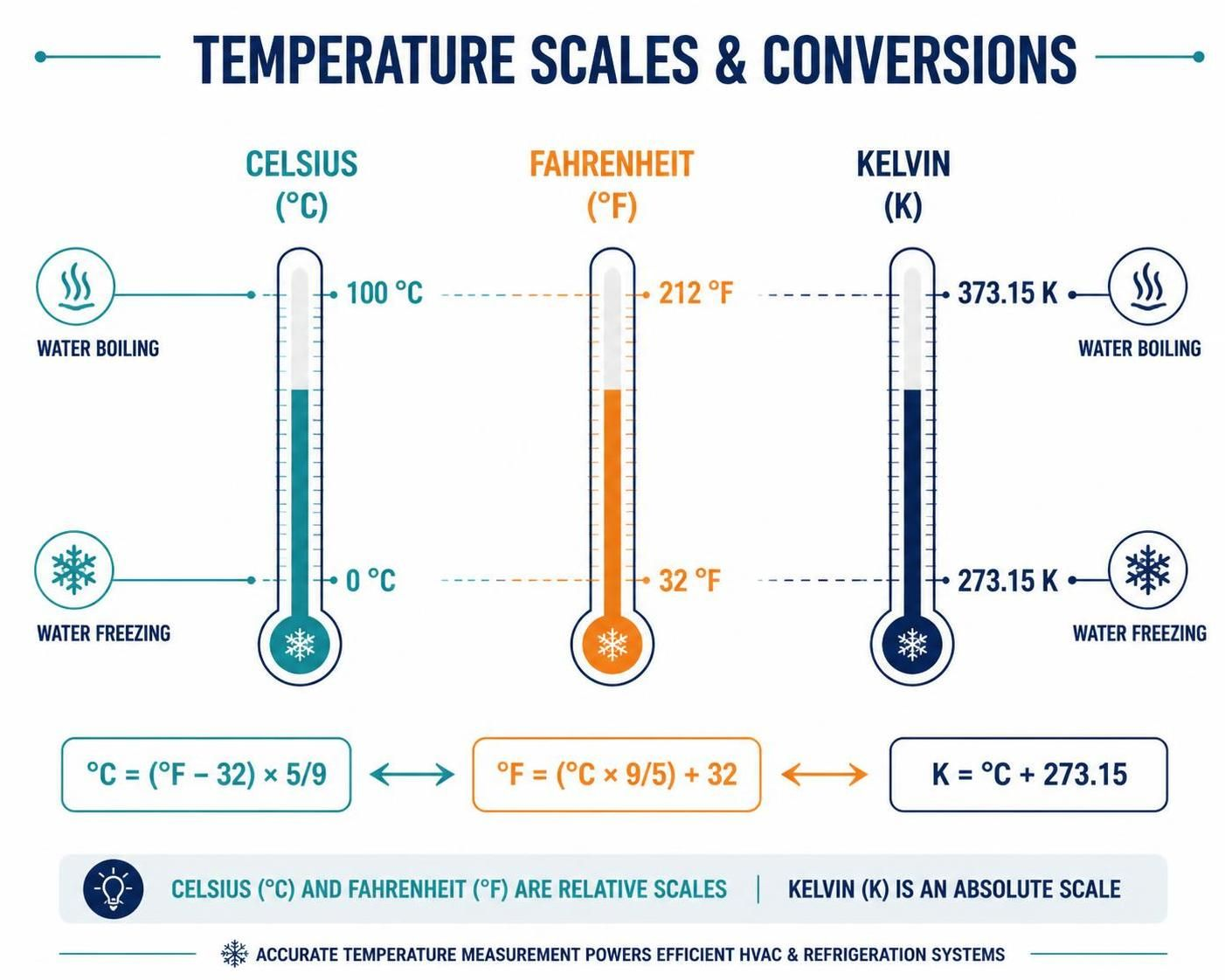
The Celsius scale is based on the freezing and boiling points of water at standard atmospheric pressure:
Water freezes at 0°C
Water boils at 100°C
There are therefore 100 Celsius degrees between these two reference points.
Examples in HVAC and refrigeration
Application
Typical temperature example
Air-conditioned room
20°C–24°C
Pharmaceutical cold storage
+2°C to +8°C
Chilled food storage
Approximately 0°C–5°C
General cold room
Approximately 0°C to +5°C
Frozen food storage
Around -18°C
Deep-freezing applications
Below -18°C
Ice production
Around 0°C or below, depending on the process
Actual operating temperatures depend on the product, equipment design, process requirements and applicable standards.
2. Fahrenheit (°F)
The Fahrenheit scale is widely used in the United States and is encountered frequently when working with HVAC and refrigeration equipment manufactured for the North American market.
On the Fahrenheit scale:
Water freezes at 32°F
Water boils at 212°F
Therefore, the difference between the freezing and boiling points of water is 180°F.
This means that one degree Fahrenheit represents a smaller temperature interval than one degree Celsius.
For example:
20°C = 68°F
and:
-18°C ≈ 0°F
This is why refrigeration equipment specifications originating from the United States may use Fahrenheit even when the same equipment is being operated elsewhere.
3. Kelvin (K)
The Kelvin is the SI unit of thermodynamic temperature.
Unlike Celsius and Fahrenheit, Kelvin is an absolute temperature scale.
Kelvin does not use the degree symbol.
Correct:
273.15 K
Not:
273.15°K
The Kelvin scale begins at absolute zero, the theoretical lower limit of thermodynamic temperature.
Absolute zero is:
0 K = -273.15°C = -459.67°F
The size of one Kelvin is the same as the size of one Celsius degree.
Therefore:
1 K temperature difference = 1°C temperature difference
However, their zero points are different.
For example:
0°C = 273.15 K
25°C = 298.15 K
-18°C = 255.15 K
Kelvin is particularly useful in engineering calculations involving:
Thermodynamics
Refrigeration cycles
Gas laws
Heat transfer
Compressor calculations
Refrigerant properties
Coefficient of performance calculations
Absolute temperature relationships
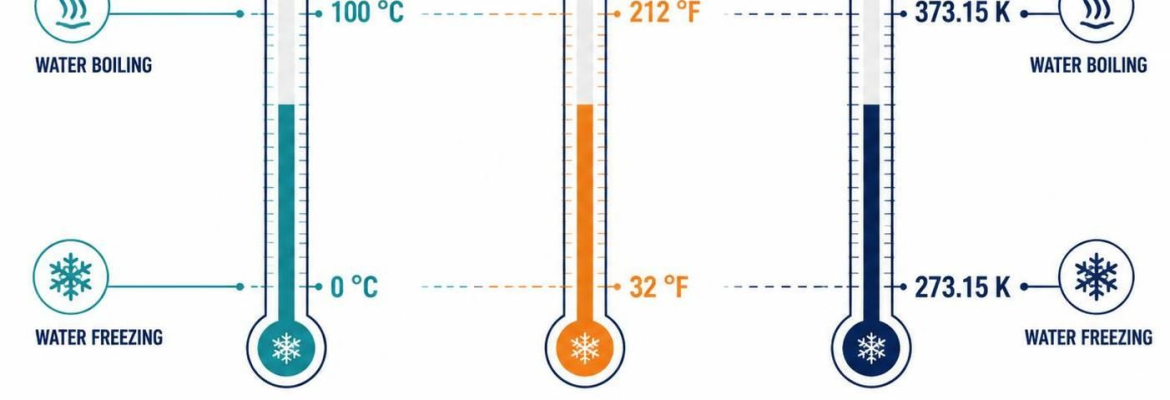
Visual Illustration 1: Celsius, Fahrenheit and Kelvin
Celsius vs Fahrenheit vs Kelvin
The three scales can describe the same physical temperature, but they use different numerical values.
Temperature
Celsius
Fahrenheit
Kelvin
Absolute zero
-273.15°C
-459.67°F
0 K
Water freezing point
0°C
32°F
273.15 K
Comfortable room temperature
20°C
68°F
293.15 K
Room temperature
25°C
77°F
298.15 K
Water boiling point
100°C
212°F
373.15 K
Typical frozen-food storage
-18°C
approximately 0°F
255.15 K
The numbers are different, but they describe the same thermal condition.
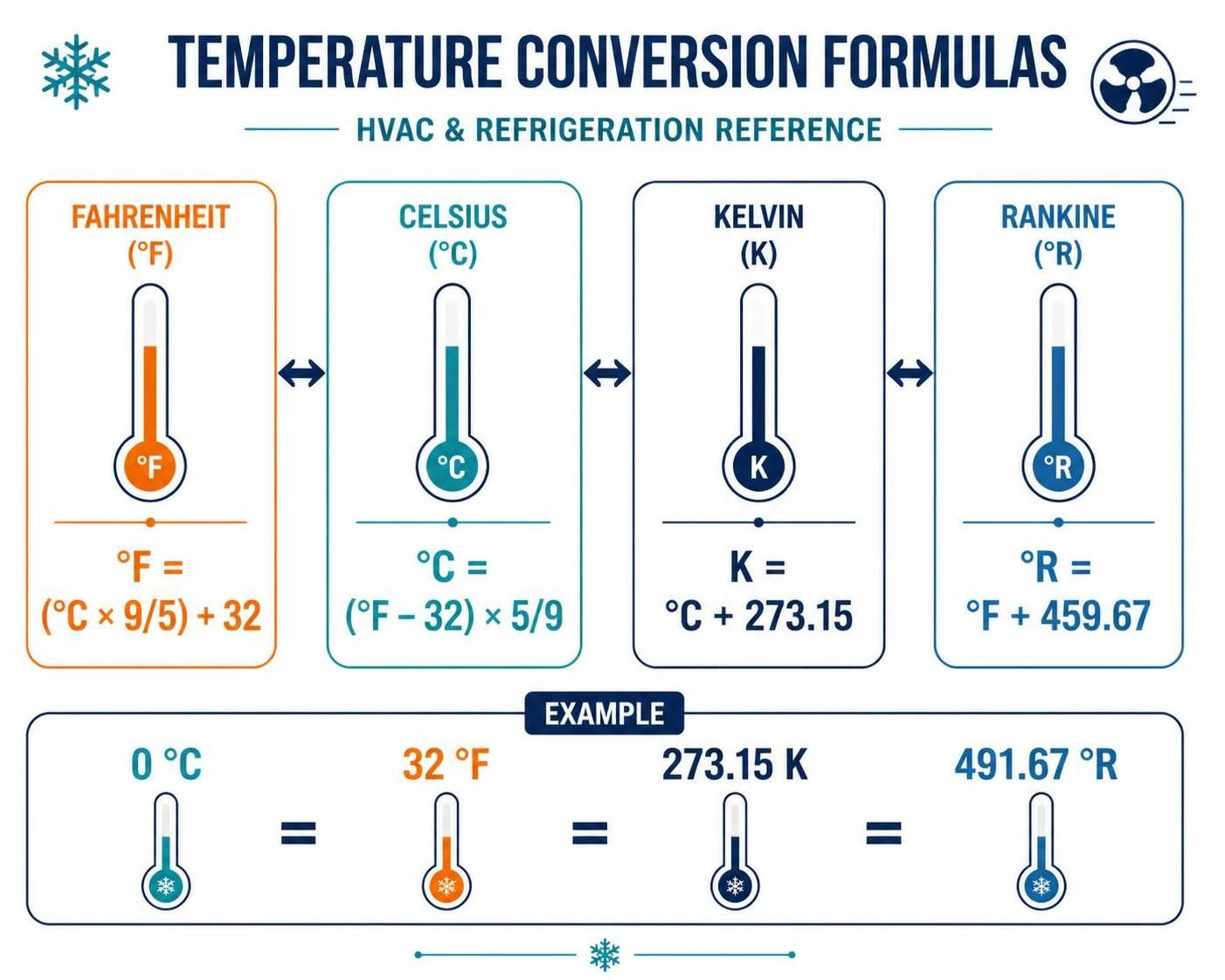
Temperature Conversion Formulas
HVAC and refrigeration professionals may need to convert temperatures between Celsius, Fahrenheit and Kelvin.
Celsius to Fahrenheit
The formula is:
°F = (°C × 9/5) + 32
Example
Convert 5°C to Fahrenheit:
°F = (5 × 9/5) + 32
°F = 9 + 32
°F = 41°F
Therefore:
5°C = 41°F
Fahrenheit to Celsius
The formula is:
°C = (°F – 32) × 5/9
Example
Convert 41°F to Celsius:
°C = (41 – 32) × 5/9
°C = 9 × 5/9
°C = 5°C
Therefore:
41°F = 5°C
Celsius to Kelvin
The formula is:
K = °C + 273.15
Example
Convert -18°C to Kelvin:
K = -18 + 273.15
K = 255.15 K
Therefore:
-18°C = 255.15 K
Kelvin to Celsius
The formula is:
°C = K – 273.15
Example
Convert 293.15 K to Celsius:
°C = 293.15 – 273.15
°C = 20°C
Therefore:
293.15 K = 20°C
Fahrenheit to Kelvin
The formula is:
K = (°F – 32) × 5/9 + 273.15
Example
Convert 32°F to Kelvin:
K = (32 – 32) × 5/9 + 273.15
K = 273.15 K
Therefore:
32°F = 273.15 K
Kelvin to Fahrenheit
The formula is:
°F = (K – 273.15) × 9/5 + 32
Example
Convert 273.15 K to Fahrenheit:
°F = (273.15 – 273.15) × 9/5 + 32
°F = 32°F
Therefore:
273.15 K = 32°F
Visual Illustration 2: Temperature Conversion
Temperature Difference vs Temperature
One of the most important concepts in HVAC and refrigeration is the difference between temperature and temperature difference.
A temperature tells us how hot or cold something is.
A temperature difference tells us how far apart two temperatures are.
For example:
Return air = 24°C
Supply air = 14°C
The temperature difference is:
24°C – 14°C = 10°C
Therefore, the air-conditioning system has a 10°C temperature difference between return and supply air.
When discussing a temperature difference, a difference of 10°C is equivalent in magnitude to 10 K.
However, this does not mean that 10°C and 10 K represent the same absolute temperature.
Why Temperature Difference Matters in HVAC
Temperature difference is commonly used when evaluating HVAC system performance.
For example:
             AIR-CONDITIONING UNIT

        RETURN AIR
           24°C
            │
            ▼
      ┌─────────────┐
      │     HVAC    │
      │     UNIT    │
      └──────┬──────┘
             │
             ▼
        SUPPLY AIR
           14°C

       Temperature Difference:

              24 - 14
                = 10°C
The actual expected temperature difference depends on the equipment, system design, airflow, indoor conditions, load and operating conditions.
It should therefore not be assumed that every air-conditioning system must produce the same temperature difference.
Visual Illustration 3: HVAC Supply and Return Air Temperatures
Temperature measurement becomes even more important in refrigeration.
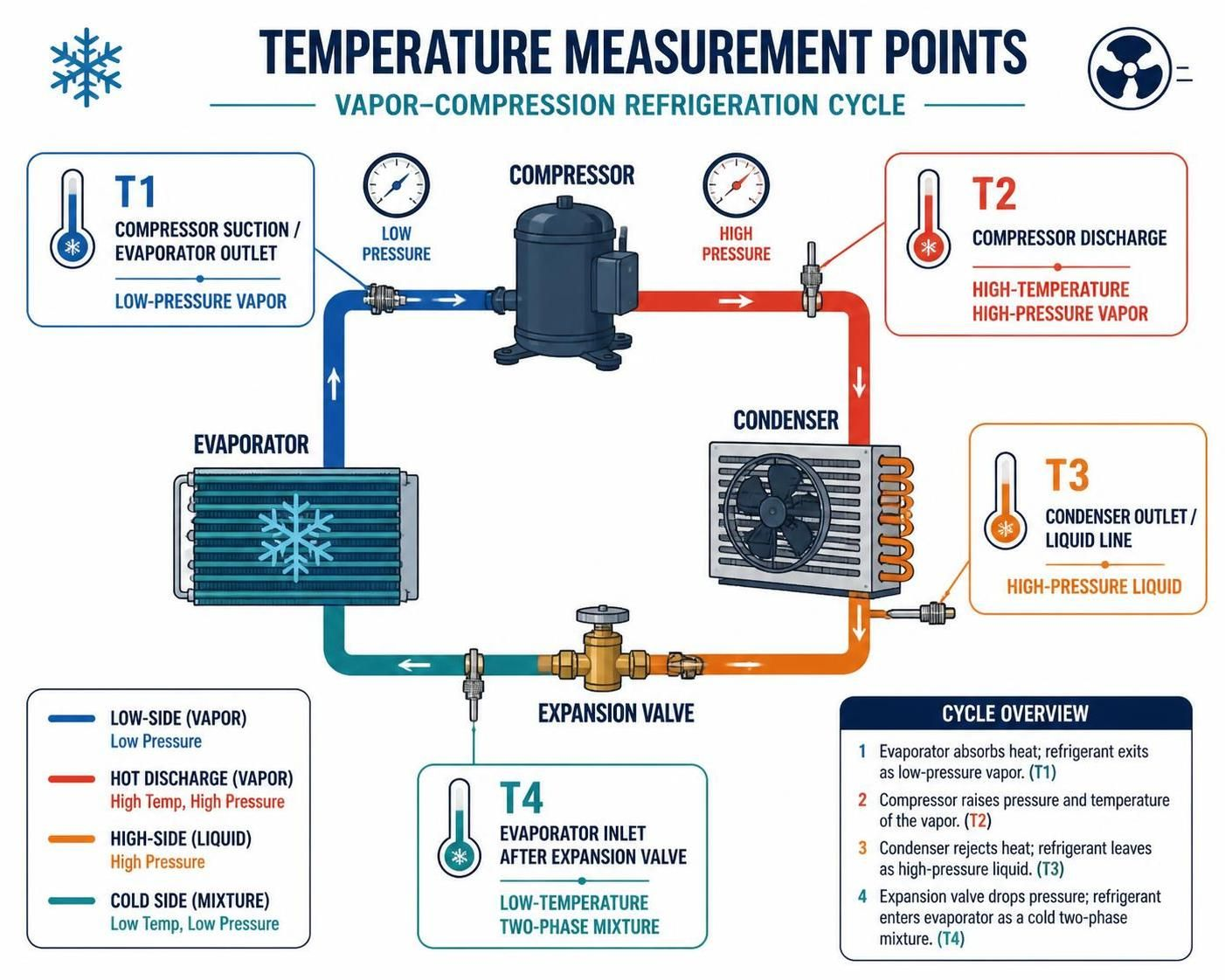
A refrigeration system can contain several different temperatures at the same time.
For example, a refrigeration system may have:
Cold-room air temperature
Product temperature
Evaporator temperature
Refrigerant suction temperature
Compressor discharge temperature
Condensing temperature
Liquid refrigerant temperature
Outdoor ambient temperature
These temperatures are related to the operation of the refrigeration cycle but are not necessarily the same.
A cold room operating at -18°C, for example, does not mean that the refrigerant leaving the evaporator must also be at -18°C.
The refrigeration system requires a temperature difference between the refrigerated space and the evaporating refrigerant to transfer heat from the room into the refrigeration system.
Refrigeration Temperature vs Room Temperature
This distinction is important when designing and troubleshooting cold rooms.
Consider a freezer operating at:
Room temperature = -18°C
The evaporating refrigerant temperature may be lower than the room temperature.
The exact evaporating temperature depends on factors including:
Refrigerant
Evaporator design
Airflow
Required temperature difference
Evaporator size
Compressor capacity
Operating conditions
System design
Therefore, the room temperature, evaporating temperature and refrigerant temperature should not be treated as interchangeable measurements.
Visual Illustration 4: Temperatures Through a Refrigeration System
Common Refrigeration Temperature Ranges
Different refrigeration applications require different temperature ranges.
There is no single temperature that applies to all refrigeration systems.
Application
Example temperature range
Comfort air conditioning
Approximately 20°C–24°C
Chilled storage
Approximately 0°C–5°C
Pharmaceutical cold storage
Commonly +2°C to +8°C
Frozen-food storage
Approximately -18°C
Deep-freezing
Below -18°C
Ice production
Around 0°C or below, depending on process
Blast freezing
Often below -30°C, depending on application
Ultra-low-temperature applications
Can be below -40°C
These are general examples, not universal design requirements. The required temperature should always be determined by the product, process, applicable standards and equipment design.
Quick HVAC and Refrigeration Temperature Conversion Chart
°C
°F
K
-40
-40
233.15
-30
-22
243.15
-20
-4
253.15
-18
approximately 0
255.15
-10
14
263.15
0
32
273.15
2
35.6
275.15
5
41
278.15
8
46.4
281.15
10
50
283.15
15
59
288.15
20
68
293.15
24
75.2
297.15
25
77
298.15
30
86
303.15
40
104
313.15
50
122
323.15
Values are rounded where appropriate.
Practical Examples
Example 1: Pharmaceutical Cold Room
Suppose a pharmaceutical cold room is designed to maintain:
+2°C to +8°C
The equivalent Fahrenheit range is approximately:
35.6°F to 46.4°F
The equivalent Kelvin range is:
275.15 K to 281.15 K
Example 2: Frozen Food Cold Room
Suppose frozen products are stored at:
-18°C
This is approximately:
0°F
and:
255.15 K
Example 3: Air-Conditioned Room
Suppose an indoor environment is maintained at:
24°C
This corresponds to:
75.2°F
and:
297.15 K
Example 4: HVAC Temperature Difference
Suppose:
Return air = 25°C
and:
Supply air = 15°C
Then:
ΔT = 25°C – 15°C
ΔT = 10°C
The temperature difference is therefore 10 K as a temperature interval.
Important: Temperature Is Not the Same as Cooling Capacity
A common misunderstanding in HVAC and refrigeration is to treat temperature as a measure of cooling capacity.
It is not.
Temperature tells us how hot or cold something is.
Cooling capacity describes the rate at which a refrigeration or air-conditioning system can remove heat.
Cooling capacity may be expressed in units such as:
BTU/h
kW
Ton of refrigeration
For example, two air-conditioning systems can both maintain a room at 24°C while having completely different cooling capacities.
The required cooling capacity depends on factors such as:
Building size
Outdoor temperature
Solar heat gain
Occupancy
Lighting
Equipment heat
Air infiltration
Building envelope
Desired indoor condition
Operating schedule
Similarly, two cold rooms can both operate at -18°C but require different refrigeration capacities because of differences in size, product load, insulation, door openings, ambient conditions and operating requirements.
Temperature Is Critical to Cold-Chain Integrity
In cold-chain applications, maintaining the correct temperature is not simply about making a room cold.
The refrigeration system must maintain the required conditions throughout the intended operating period.
This can involve:
Correct refrigeration capacity
Proper insulation
Appropriate evaporator selection
Correct compressor selection
Adequate condenser capacity
Proper airflow
Door management
Temperature monitoring
Defrost management
Backup power
Correct control systems
Appropriate installation and commissioning
For solar-powered or off-grid refrigeration systems, temperature requirements also influence the sizing of the refrigeration equipment and the electrical/solar energy system.
Conclusion
Temperature is a fundamental measurement in both HVAC and refrigeration engineering.
The three most important temperature scales encountered in these fields are:
Celsius (°C), Fahrenheit (°F), and Kelvin (K).
Celsius is widely used for everyday HVAC and refrigeration applications, Fahrenheit remains common in the United States and some international equipment documentation, while Kelvin is the SI unit of thermodynamic temperature and is important in engineering calculations.
Understanding the difference between:
Absolute temperature
Temperature difference
Room temperature
Refrigerant temperature
Evaporating temperature
Condensing temperature
Dry-bulb temperature
Wet-bulb temperature
Dew-point temperature
Setpoint temperature
is essential for correctly interpreting HVAC and refrigeration systems.
Most importantly, the temperature displayed by a controller is only one part of understanding system performance. Proper system design requires consideration of cooling capacity, heat load, equipment selection, airflow, refrigerant conditions, insulation, controls and the specific requirements of the application.
Whether the application involves an air-conditioning system, cold room, freezer, pharmaceutical storage facility, blast freezer or other temperature-controlled environment, accurate temperature measurement is fundamental to reliable operation.
Frequently Asked Questions
What are the main temperature units used in HVAC?
The main temperature units encountered in HVAC are degrees Celsius (°C), degrees Fahrenheit (°F), and Kelvin (K).
What temperature scale is commonly used in Nigeria for HVAC and refrigeration?
Celsius (°C) is commonly used in Nigeria for HVAC, refrigeration and engineering applications.
Is -18°C the same as -18°F?
No. -18°C is approximately 0°F. Celsius and Fahrenheit use different scales.
Is 0°C the same as 0 K?
No. 0°C = 273.15 K. Absolute zero is 0 K, which is -273.15°C.
What is the difference between Celsius and Kelvin?
Celsius and Kelvin have the same size temperature interval, but their zero points are different. 0°C = 273.15 K.
Why is Kelvin used in refrigeration engineering?
Kelvin is an absolute temperature scale and is used in thermodynamic and engineering calculations where absolute temperature is required.
What temperature is a typical freezer set to?
Many frozen-food storage applications use approximately -18°C, although the required temperature depends on the product, process and applicable requirements.
What temperature is used for pharmaceutical cold storage?
A commonly encountered pharmaceutical storage range is +2°C to +8°C, but the required range must be determined from the specific product and applicable storage requirements.
Why are temperature differences important in HVAC?
Temperature differences are used to evaluate conditions such as supply-air versus return-air temperature and are also fundamental to heat transfer and refrigeration-cycle analysis.
Can a cold room at -18°C have refrigerant colder than -18°C?
Yes. The evaporating refrigerant temperature can be lower than the cold-room air temperature so that heat can be transferred from the room into the refrigeration system. The exact temperature depends on the system design and operating conditions.
Akpo Oyegwa Refrigeration Company (AORC)provides refrigeration, air-conditioning, cold-room and solar-powered refrigeration solutions for commercial, industrial and other temperature-controlled applications in Nigeria.
Our services include refrigeration system design and installation, cold rooms, freezers, HVAC/R systems, solar-powered cold storage solutions, solar-powered refrigeration systems, equipment supply, maintenance and related technical services.
For a temperature-controlled project, the correct temperature requirement is only the starting point. Proper equipment selection and system design require consideration of the required temperature, heat load, storage capacity, product characteristics, ambient conditions, operating schedule and power requirements.