HVAC Cooling Capacity Explained: BTU, kW, HP and Ton (TR)
When specifying an air conditioner, cold room, freezer, blast freezer or refrigeration system, one of the most important technical specifications is cooling capacity.
Cooling capacity is commonly expressed using different units, including:
BTU/h — British Thermal Units per hour
kW — kilowatts of cooling capacity
HP — horsepower, commonly used as a refrigeration compressor size reference
TR or Ton — refrigeration ton
HVAC Cooling Capacity Conversion
❄️
BTU to HP Calculator
Air Conditioner Cooling Capacity Converter
Formula: HP = BTU ÷ 9,000
Common: 9000 = 1HP, 12000 = 1.5HP, 18000 = 2HP
Quick Select:
Equivalent Horsepower
0 HP
Calculating...
9,000 BTU 1.0 HP
12,000 BTU 1.5 HP
18,000 BTU 2.0 HP
24,000 BTU 2.5 HP
Because manufacturers, contractors and customers may use different units, it is important to understand what each unit means and how they relate to one another.
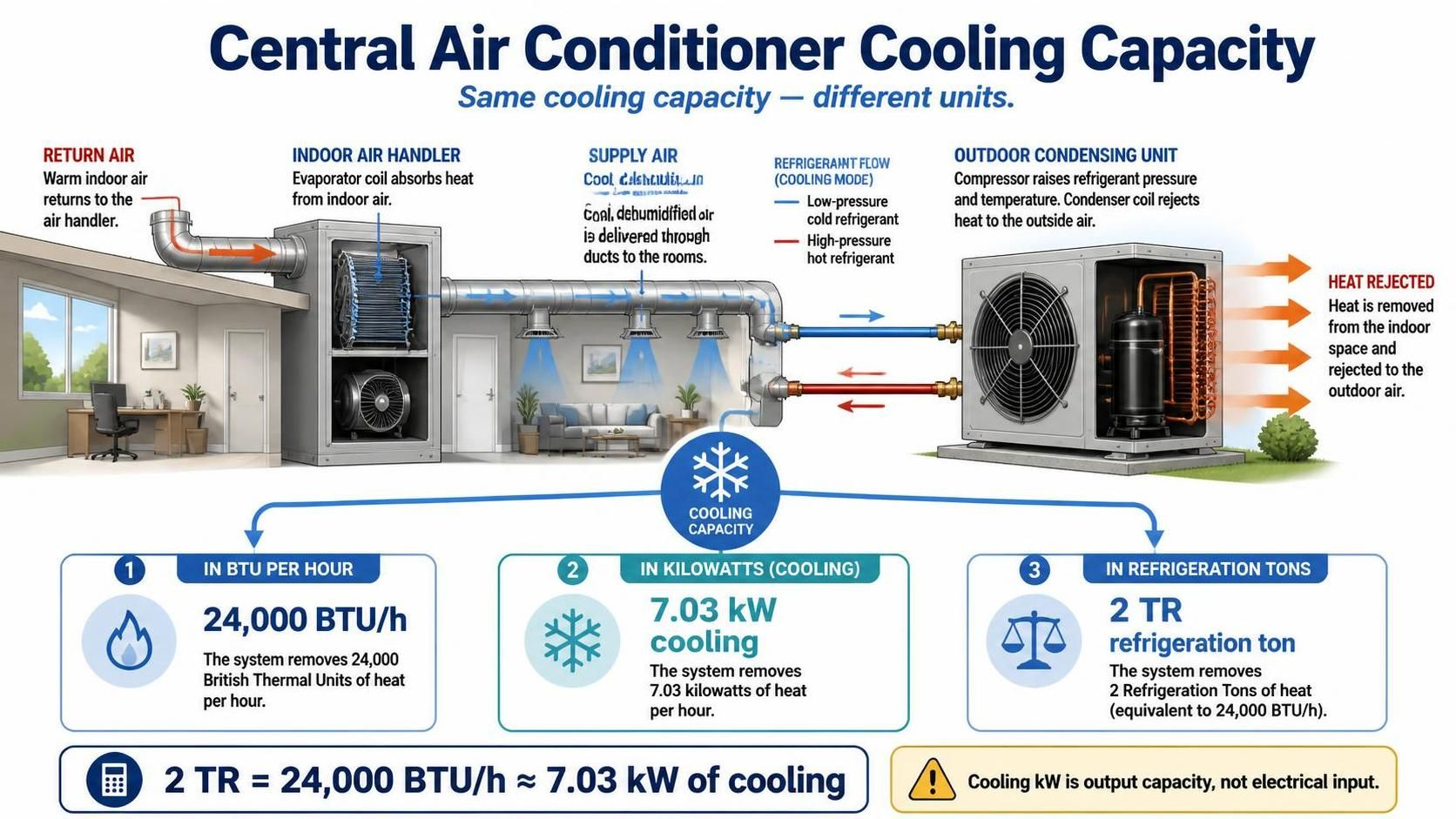
For example, an HVAC system may be described as a 24,000 BTU/h air conditioner, while another manufacturer may describe a similar cooling capacity as approximately 7.03 kW or 2 TR.
However, BTU/h, kW and refrigeration ton are units of cooling capacity, while HP is primarily a measure of mechanical power and is often used in refrigeration to describe compressor motor size. Therefore, HP cannot be converted to cooling capacity accurately using one universal conversion factor.
Cooling capacity is the rate at which a refrigeration or air-conditioning system can remove heat from a space, product, process or environment.
A refrigeration system does not simply “produce cold.” Instead, it removes heat.
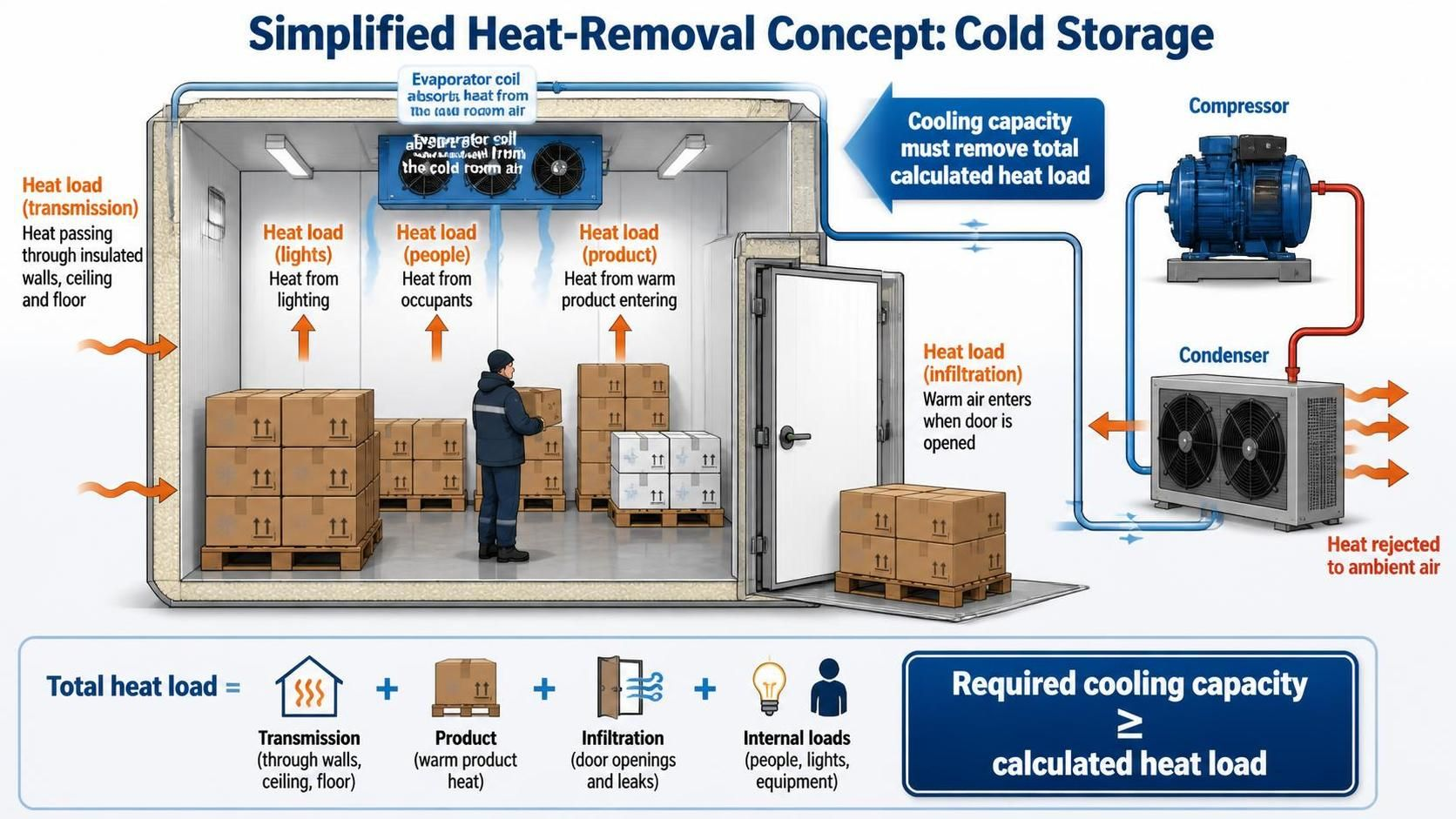
For a cold room, for example, the refrigeration system must remove heat entering the room from sources such as:
Warm products entering the room
Heat passing through the walls, floor and ceiling
People entering the room
Lighting
Evaporator and fan motors
Door openings
Infiltration of warm and humid air
Defrosting
Equipment operating inside the room
The total heat load determines the required refrigeration capacity.
Simplified heat-removal concept
The refrigeration system must have sufficient capacity to remove the calculated heat load while maintaining the required temperature.
1. What Does BTU/h Mean?
BTU/h means British Thermal Units per hour.
BTU is a traditional unit of heat energy. When expressed as BTU/h, it describes a rate of heat transfer.
In HVAC and refrigeration, BTU/h is commonly used to specify cooling capacity.
For example:
HVAC Capacity
Approximate Cooling Capacity
9,000 BTU/h
2.64 kW
12,000 BTU/h
3.52 kW
18,000 BTU/h
5.28 kW
24,000 BTU/h
7.03 kW
36,000 BTU/h
10.55 kW
48,000 BTU/h
14.07 kW
60,000 BTU/h
17.58 kW
A commonly used conversion is:
1 kW of cooling ≈ 3,412 BTU/h
Therefore:
kW = BTU/h ÷ 3,412
and:
BTU/h = kW × 3,412
Example
Suppose an air conditioner has a rated cooling capacity of:
24,000 BTU/h
Then:
24,000 ÷ 3,412 ≈ 7.03 kW
Therefore, a 24,000 BTU/h air conditioner has approximately 7.03 kW of cooling capacity.
2. What Is a Kilowatt (kW) of Cooling?
The kilowatt (kW) is an SI unit of power.
In refrigeration and HVAC specifications, kW can be used to describe cooling capacity.
This should not be confused with the electrical power consumed by the equipment.
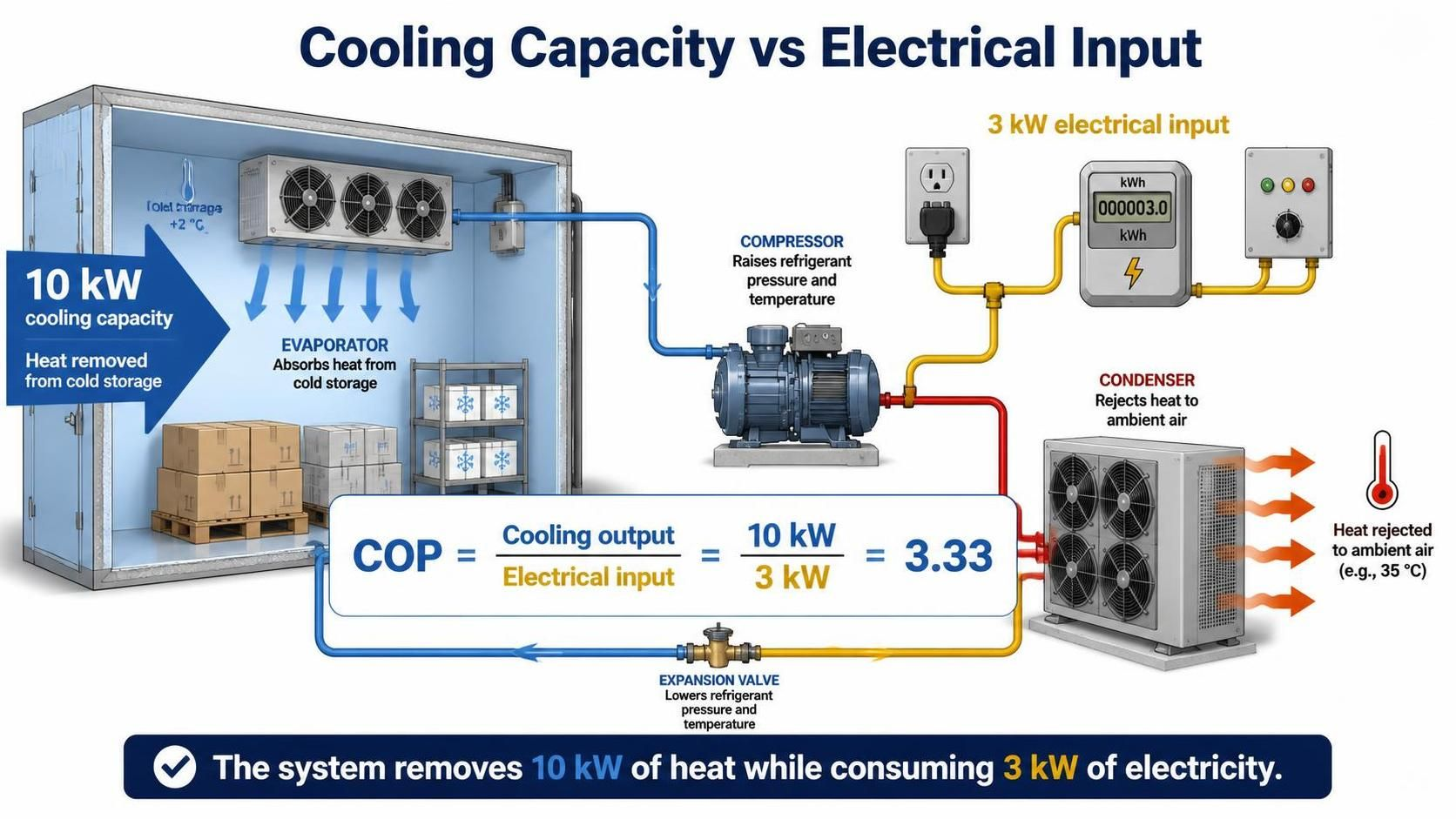
For example, a refrigeration system may have:
10 kW cooling capacity
while consuming:
3 kW electrical power
These are two different quantities.
The first describes how much heat the system can remove.
The second describes how much electrical power the equipment requires.
Cooling capacity versus electrical input
This distinction is particularly important when designing solar-powered refrigeration systems, generators, batteries and electrical distribution systems.
3. Cooling kW Is Not the Same as Electrical kW
This is one of the most important concepts in HVAC and refrigeration.
If a refrigeration system is rated at 10 kW cooling capacity, this does not necessarily mean that it consumes 10 kW of electricity.
The relationship between cooling output and electrical input is influenced by the system’s efficiency.
For example:
Cooling capacity = 10 kW
Electrical input = 3 kW
The approximate coefficient of performance (COP) would be:
COP = Cooling Capacity ÷ Electrical Input
COP = 10 ÷ 3
COP ≈ 3.33
A higher COP generally means more cooling is produced for each unit of electrical energy consumed, although actual performance depends on operating conditions.
4. What Is a Refrigeration Ton (TR)?
A refrigeration ton, commonly written as TR, is a traditional unit of refrigeration capacity.
It is not the same thing as a tonne of mass.
This distinction is extremely important in cold storage.
Refrigeration ton
A refrigeration ton measures cooling capacity.
Metric tonne
A metric tonne measures mass.
Therefore:
1 TR ≠ 1 tonne of product
A cold room storing 10 tonnes of chicken does not necessarily require a 10-ton refrigeration system.
The required refrigeration capacity must be calculated from the actual heat load.
1 Refrigeration Ton = 12,000 BTU/h
The commonly used relationship is:
1 TR = 12,000 BTU/h
Using the BTU-to-kW relationship:
1 TR ≈ 3.517 kW of cooling
Therefore:
Refrigeration Capacity
BTU/h
Approx. kW
1 TR
12,000
3.52
2 TR
24,000
7.03
3 TR
36,000
10.55
5 TR
60,000
17.58
10 TR
120,000
35.17
20 TR
240,000
70.34
5. Why Is It Called a “Ton” of Refrigeration?
The refrigeration ton originated from the historical amount of heat associated with melting a ton of ice over a defined period.
Today, the term is simply used as a standardized measure of refrigeration capacity.
It should therefore not be interpreted as the physical weight of a refrigeration machine or the quantity of product that can be stored.
6. What Does HP Mean in Refrigeration?
HP means horsepower.
Horsepower is fundamentally a unit of mechanical power, not cooling capacity.
In refrigeration, however, compressor sizes are frequently described using horsepower.
For example, a compressor may be marketed as:
1 HP
2 HP
3 HP
5 HP
7.5 HP
10 HP
15 HP
20 HP
This can create confusion because people sometimes assume that:
1 HP = a fixed amount of cooling capacity
That is not technically correct.
7. What Does HP Mean in Air Conditioning?
HP means horsepower.
In physics, horsepower is a unit of power, not directly a unit of cooling capacity.
One mechanical horsepower is approximately:
1 HP ≈ 0.746 kW
However, HVAC manufacturers and markets often use terms such as:
1 HP air conditioner
1.5 HP air conditioner
2 HP air conditioner
2.5 HP air conditioner
3 HP air conditioner
5 HP air conditioner
In this context, HP is commonly used as an approximate equipment-size designation rather than a precise measurement of cooling capacity.
This distinction is particularly important when comparing air-conditioning systems from different manufacturers.
8. Why HP Should Not Be Used as an Exact Cooling-Capacity Conversion
It is tempting to assume:
1 HP air conditioner = a fixed number of BTU/h.
However, there is no universal engineering rule that makes this exact.
Two air conditioners both marketed as 1.5 HP may have different:
cooling capacities
compressor technologies
efficiencies
rated operating conditions
refrigerants
evaporator designs
condenser designs
Consequently, when selecting HVAC equipment, the manufacturer’s rated cooling capacity in BTU/h or kW is more precise than relying on HP alone.
Example
Instead of specifying only:
“Supply a 2 HP air conditioner.”
A more technically precise specification would state something such as:
Cooling capacity: approximately 24,000 BTU/h (7.0 kW), subject to specified rating conditions.
The actual equipment model and manufacturer’s data sheet should then be checked.
For example, an inverter air conditioner may operate at different capacities depending on its compressor speed and the thermal load.
Therefore, a capacity such as 24,000 BTU/h should be understood as a rated or nominal capacity, not necessarily a constant output under every operating condition.
Nominal Capacity vs Actual Operating Capacity
Manufacturers normally provide technical data showing how an HVAC system performs under specified test or rating conditions.
For professional HVAC selection, engineers should therefore consider the manufacturer’s:
rated cooling capacity
minimum cooling capacity
maximum cooling capacity
rated power input
COP
EER/SEER where applicable
operating temperature range
refrigerant type
airflow
electrical requirements
Rather than selecting equipment based only on a label such as “2 HP” or “3 HP.”
Example: Converting a 36,000 BTU/h Air Conditioner
Suppose an air conditioner has a nominal capacity of:
36,000 BTU/h
Convert to kW
36,000 ÷ 3,412
≈ 10.55 kW
Convert to refrigeration tons
36,000 ÷ 12,000
= 3 TR
Therefore:
36,000 BTU/h ≈ 10.55 kW ≈ 3 TR
This does not mean that the air conditioner consumes 10.55 kW of electricity.
Its actual electrical consumption must be obtained from the manufacturer’s electrical input specifications.
Example: Converting 5 TR
Suppose a commercial HVAC system has a capacity of:
5 TR
Convert to BTU/h
5 × 12,000
= 60,000 BTU/h
Convert to kW
5 × 3.517
≈ 17.59 kW
Therefore:
5 TR ≈ 60,000 BTU/h ≈ 17.59 kW cooling capacity
Again, 17.59 kW is the approximate cooling output, not necessarily the electrical consumption.
Quick HVAC Conversion Formulas
BTU/h → kW
kW = BTU/h ÷ 3,412
kW → BTU/h
BTU/h = kW × 3,412
BTU/h → TR
TR = BTU/h ÷ 12,000
TR → BTU/h
BTU/h = TR × 12,000
TR → kW
kW = TR × 3.517
kW → TR
TR = kW ÷ 3.517
These formulas are useful for comparing HVAC equipment specifications presented using different units.
Is 1 HP Equal to 1 TR?
No.
This is a common misconception in the air-conditioning market.
HP and TR represent different concepts.
HP is a unit of power and is also commonly used as an HVAC equipment-size designation.
TR is a unit of refrigeration capacity.
Therefore, it is not technically correct to establish a universal:
1 HP = X TR
conversion for air-conditioning capacity.
If an HVAC supplier specifies equipment in HP, the actual manufacturer’s data sheet should be checked for the corresponding BTU/h or kW cooling capacity.
Why BTU/h, kW and TR Are Better for Technical HVAC Specifications
When preparing a professional HVAC quotation, tender, specification or engineering document, it is generally clearer to state the actual cooling capacity.
For example:
Cooling capacity: 24,000 BTU/h (7.03 kW, approximately 2 TR)
rather than simply:
2 HP air conditioner
The first specification gives considerably more useful engineering information.
The equipment model should also be included where precise equipment selection is required.
HVAC Cooling Capacity Comparison
Measurement
What It Represents
Direct Cooling Capacity?
BTU/h
Rate of heat removal
Yes
kW cooling
Rate of heat removal
Yes
TR
Refrigeration capacity
Yes
HP
Power / equipment designation
No, not directly
The key principle
BTU/h, kW and TR can be directly converted into one another because they express cooling capacity.
HP should be treated differently because it is not a direct universal measure of HVAC cooling capacity.