BTU to HP | BTU to Ton | BTU to kW Conversion Tool
HVAC and Refrigeration Cooling Capacity Conversion
Understanding HVAC and refrigeration capacity units is essential when selecting, specifying, sizing, or comparing air-conditioning and refrigeration equipment. Cooling equipment may be rated in BTU/h, horsepower (HP), tons of refrigeration (TR), or kilowatts (kW) depending on the manufacturer, application, and country.
At Akpo Oyegwa Refrigeration Company, we work with different types of air-conditioning, refrigeration, cold-room, and cooling systems where accurate understanding of cooling capacity is important for equipment selection and system design.
This guide explains how to convert BTU to HP, BTU to tons, BTU to kW, and other commonly used HVAC and refrigeration capacity units.
HVAC/R Cooling Capacity Conversion Tool
BTU to HP | BTU to Ton | BTU to kW | Conversion Tool & Calculator
❄️ Cooling Capacity Converter
AKPO OYEGWA REFRIGERATION CO. (A.O.R.C)
Horse Power0HP
Tonnage0TON
Kilowatts0kW
Formula Used:
1 TON = 12,000 BTU/hr | 1 kW = 3,412.14 BTU/hr | 1 HP ≈ 9,000 BTU/hr (Industry Standard for AC)
What Is BTU in HVAC and Refrigeration?
BTU means British Thermal Unit. It is a unit of energy traditionally used to describe the amount of heat required to raise the temperature of one pound of water by approximately 1°F.
In HVAC and refrigeration, capacity is commonly expressed as BTU per hour (BTU/h or BTU/hr).
For example:
9,000 BTU/h air conditioner
12,000 BTU/h air conditioner
18,000 BTU/h air conditioner
24,000 BTU/h air conditioner
36,000 BTU/h air conditioner
A higher BTU/h rating generally represents a greater rate of heat removal, assuming the ratings are being compared on the same basis.
Important: BTU is not the same as BTU/h
BTU is a unit of energy, while BTU/h is a rate of heat transfer.
When discussing the cooling capacity of an air conditioner, chiller, refrigeration system, cold room or freezer, the more appropriate term is usually BTU/h.
Kilowatt (kW) is an SI unit commonly used for power and is widely used in electrical and engineering applications.
For cooling capacity:
1 kW of cooling capacity ≈ 3,412 BTU/h
Therefore:
kW = BTU/h ÷ 3,412
Examples
9,000 BTU/h to kW:
9,000 ÷ 3,412 ≈ 2.64 kW
12,000 BTU/h to kW:
12,000 ÷ 3,412 ≈ 3.52 kW
18,000 BTU/h to kW:
18,000 ÷ 3,412 ≈ 5.28 kW
24,000 BTU/h to kW:
24,000 ÷ 3,412 ≈ 7.03 kW
36,000 BTU/h to kW:
36,000 ÷ 3,412 ≈ 10.55 kW
BTU/h to kW conversion formula
Cooling Capacity (kW) = BTU/h ÷ 3,412
Conversely:
BTU/h = kW × 3,412
BTU to Tons of Refrigeration Conversion
A ton of refrigeration (TR) is a traditional unit used to describe refrigeration and air-conditioning capacity.
One ton of refrigeration is defined as:
1 TR = 12,000 BTU/h
Therefore:
TR = BTU/h ÷ 12,000
Examples
Cooling Capacity
Approx. Refrigeration Capacity
12,000 BTU/h
1 TR
24,000 BTU/h
2 TR
36,000 BTU/h
3 TR
48,000 BTU/h
4 TR
60,000 BTU/h
5 TR
120,000 BTU/h
10 TR
For example, a refrigeration system rated at 60,000 BTU/h has a nominal capacity of:
60,000 ÷ 12,000 = 5 TR
Important distinction
A ton of refrigeration is not a measurement of the physical weight of the refrigeration equipment.
It is a unit of cooling capacity.
BTU to HP Conversion
Horsepower (HP) is frequently associated with refrigeration compressors, motors, pumps, fans, and other mechanical equipment.
However, BTU/h and HP do not represent the same physical quantity.
BTU/h describes a rate of heat removal, while HP describes mechanical power.
Consequently, there is no single universal BTU/h-to-HP conversion that accurately determines the horsepower of a refrigeration compressor.
A commonly used theoretical energy relationship is:
1 mechanical HP ≈ 2,545 BTU/h
Therefore, a simple theoretical conversion can be written as:
HP ≈ BTU/h ÷ 2,545
However, this should not be used as a direct method for selecting a refrigeration compressor.
Why BTU/h cannot directly determine compressor HP
A refrigeration compressor’s required horsepower depends on several factors, including:
Refrigerant type
Evaporating temperature
Condensing temperature
Compressor efficiency
Compressor displacement
Compressor design
Refrigeration cycle
Superheat
Subcooling
Pressure ratio
Operating conditions
Manufacturer’s performance data
For example, two compressors with the same nominal horsepower can have substantially different refrigeration capacities under different operating conditions.
Therefore, when selecting a compressor, the correct approach is to use the manufacturer’s compressor performance data at the required evaporating and condensing conditions.
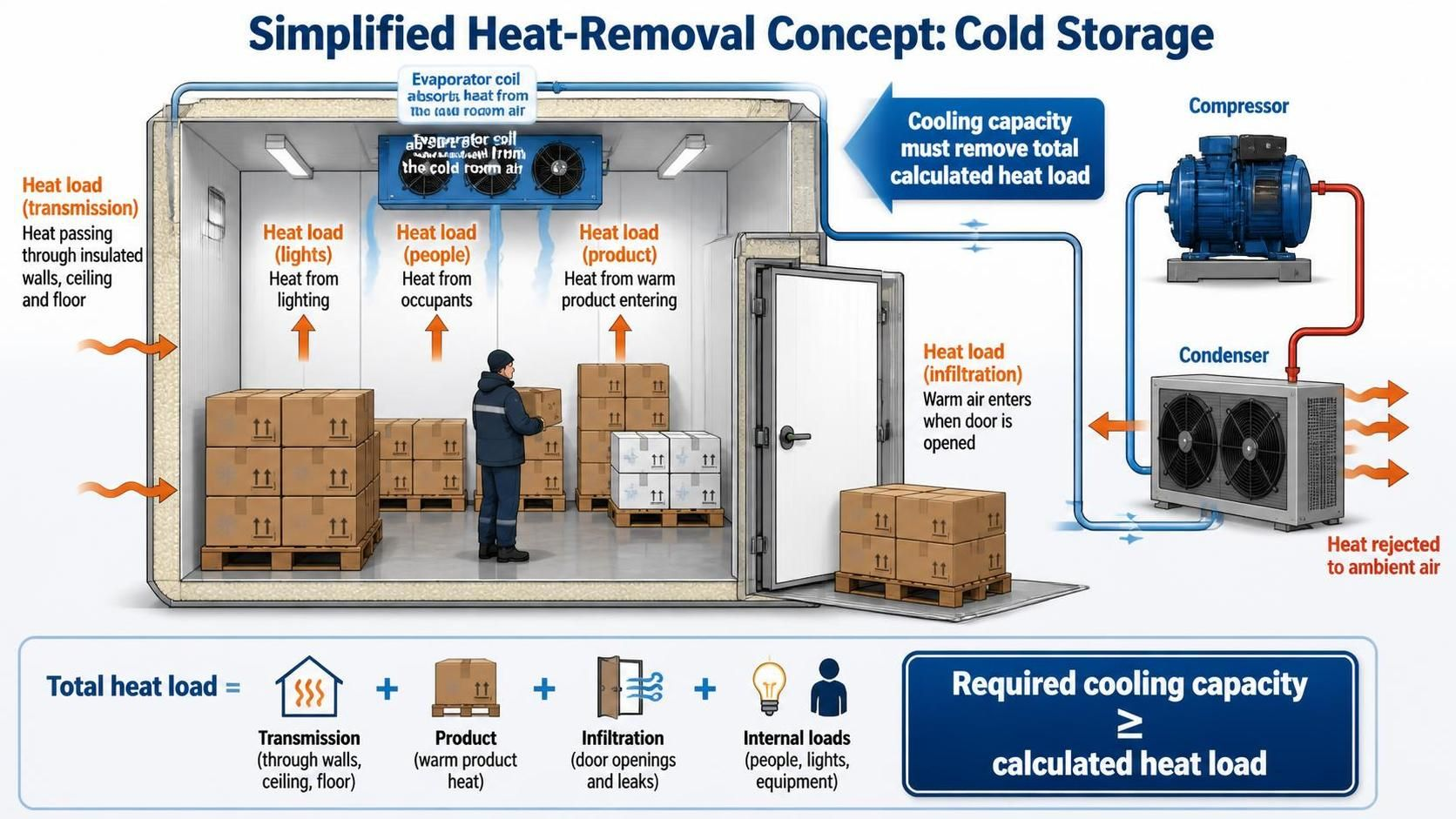
Simplified heat-removal concept
The refrigeration system must have sufficient capacity to remove the calculated heat load while maintaining the required temperature.
Ton of Refrigeration to kW
Because:
1 TR = 12,000 BTU/h
and:
1 kW ≈ 3,412 BTU/h
then:
1 TR ≈ 3.517 kW
Therefore:
kW = TR × 3.517
and:
TR = kW ÷ 3.517
Common refrigeration capacity conversions
Tons (TR)
BTU/h
Cooling Capacity
1 TR
12,000 BTU/h
3.52 kW
2 TR
24,000 BTU/h
7.03 kW
3 TR
36,000 BTU/h
10.55 kW
5 TR
60,000 BTU/h
17.58 kW
10 TR
120,000 BTU/h
35.17 kW
20 TR
240,000 BTU/h
70.34 kW
50 TR
600,000 BTU/h
175.85 kW
100 TR
1,200,000 BTU/h
351.69 kW
kW to BTU/h
To convert cooling capacity from kW to BTU/h:
BTU/h = kW × 3,412
Examples:
5 kW
5 × 3,412 = 17,060 BTU/h
10 kW
10 × 3,412 = 34,120 BTU/h
20 kW
20 × 3,412 = 68,240 BTU/h
50 kW
50 × 3,412 = 170,600 BTU/h
kW to Tons of Refrigeration
The conversion is:
TR = kW ÷ 3.517
For example:
10 kW ÷ 3.517 ≈ 2.84 TR
Therefore, a cooling capacity of 10 kW is approximately 2.84 tons of refrigeration.
Quick HVAC Cooling Capacity Conversion Table
BTU/h
kW
TR
5,000
1.47
0.42
6,000
1.76
0.50
9,000
2.64
0.75
12,000
3.52
1.00
18,000
5.28
1.50
24,000
7.03
2.00
30,000
8.79
2.50
36,000
10.55
3.00
48,000
14.07
4.00
60,000
17.58
5.00
72,000
21.10
6.00
120,000
35.17
10.00
240,000
70.34
20.00
600,000
175.85
50.00
1,200,000
351.69
100.00
Values are approximate and rounded.
HVAC and Refrigeration Capacity Conversion Formula
For quick calculations, the following formulas can be used:
BTU/h → kW
kW = BTU/h ÷ 3,412
kW → BTU/h
BTU/h = kW × 3,412
BTU/h → TR
TR = BTU/h ÷ 12,000
TR → BTU/h
BTU/h = TR × 12,000
TR → kW
kW = TR × 3.517
kW → TR
TR = kW ÷ 3.517
BTU/h → theoretical HP
HP ≈ BTU/h ÷ 2,545
Theoretical HP → BTU/h
BTU/h ≈ HP × 2,545
This distinction is particularly important when designing solar-powered refrigeration systems, generators, batteries and electrical distribution systems.
Why Accurate Cooling Capacity Conversion Matters
Correct capacity conversion is important when comparing equipment from different manufacturers or countries.
A manufacturer may specify equipment capacity in:
BTU/h
kW
TR
kcal/h
while another manufacturer may use a different unit.
Converting the figures to a common unit allows engineers, contractors, consultants, facility managers, and end users to make a meaningful technical comparison.
Capacity conversion is particularly useful during:
Equipment selection: Comparing air conditioners, chillers, compressors and refrigeration systems.
Cold-room design: Determining whether a refrigeration system provides the required cooling capacity.
Solar system design: Estimating the electrical energy requirements associated with refrigeration and air-conditioning loads.
Equipment replacement: Comparing an existing system with a proposed replacement.
Technical quotations: Communicating equipment capacity clearly to clients and project stakeholders.
Akpo Oyegwa Refrigeration Company
Akpo Oyegwa Refrigeration Company provides refrigeration, air-conditioning, HVAC, cold-room and related cooling-system services.
Our services include the supply, installation, maintenance, repair and technical support of refrigeration and HVAC systems for commercial, industrial and specialized applications.
We work with cooling systems including:
Cold rooms
Walk-in freezers
Blast freezers
Refrigeration systems
Commercial refrigeration
Industrial refrigeration
Air-conditioning systems
HVAC systems
Solar-powered cold rooms
Solar-powered refrigeration systems
Refrigeration containers
Marine HVAC and refrigeration systems
For a new refrigeration or air-conditioning project, simply converting BTU/h to HP, kW or tons is not sufficient to determine the complete system design. Proper equipment selection requires consideration of the actual heat load, operating temperature, ambient conditions, product characteristics, usage pattern, insulation, door openings and other engineering parameters.
Frequently Asked Questions
How many BTU/h is 1 ton of refrigeration?
1 ton of refrigeration = 12,000 BTU/h.
How many kW is 1 ton of refrigeration?
1 TR ≈ 3.517 kW of cooling capacity.
How many BTU/h is 1 kW?
1 kW ≈ 3,412 BTU/h.
How many HP is 12,000 BTU/h?
Using the theoretical mechanical energy conversion:
12,000 ÷ 2,545 ≈ 4.72 HP.
However, this does not mean a 12,000 BTU/h air conditioner or refrigeration system requires a 4.72 HP compressor. Compressor horsepower must be determined from the manufacturer’s performance data and operating conditions.
Is BTU the same as horsepower?
No. BTU/h measures the rate of heat transfer, while horsepower measures mechanical power. They can be related through energy-equivalent calculations, but they should not be treated as interchangeable HVAC equipment ratings.
Is 1 ton of refrigeration equal to 1 horsepower?
No. 1 TR is approximately 12,000 BTU/h of cooling capacity, whereas horsepower is a mechanical power unit. A refrigeration compressor’s horsepower cannot be reliably determined from TR alone.
Can I use BTU-to-HP conversion to select a compressor?
No. Compressor selection should be based on the manufacturer’s performance data at the required evaporating temperature, condensing temperature, refrigerant, superheat, subcooling and other operating conditions.
Conclusion
Understanding the relationship between BTU/h, kW, tons of refrigeration and horsepower makes it easier to compare HVAC and refrigeration equipment and communicate technical requirements.
The most commonly used cooling-capacity conversions are:
1 TR = 12,000 BTU/h
1 TR ≈ 3.517 kW
1 kW ≈ 3,412 BTU/h
For horsepower, the theoretical relationship is:
1 HP ≈ 2,545 BTU/h
However, the HP figure should not be used as a direct substitute for actual refrigeration compressor capacity.
For accurate HVAC and refrigeration equipment selection, cooling capacity should be determined from the application’s actual heat load and the manufacturer’s equipment performance data.
Akpo Oyegwa Refrigeration Companyprovides professional refrigeration and HVAC solutions for commercial, industrial and specialized applications.