Amps vs Voltage: Which Is More Dangerous to the Human Body?
Electricity is an essential part of modern life. It powers air-conditioning systems, refrigeration equipment, cold rooms, industrial machinery, lighting, computers and countless other devices.
However, electricity can also cause severe injury or death. Two electrical terms that are frequently mentioned when discussing electrical safety are voltage and amperage (amps).
So, which one is more dangerous to the human body: voltage or amps?
The short answer is:
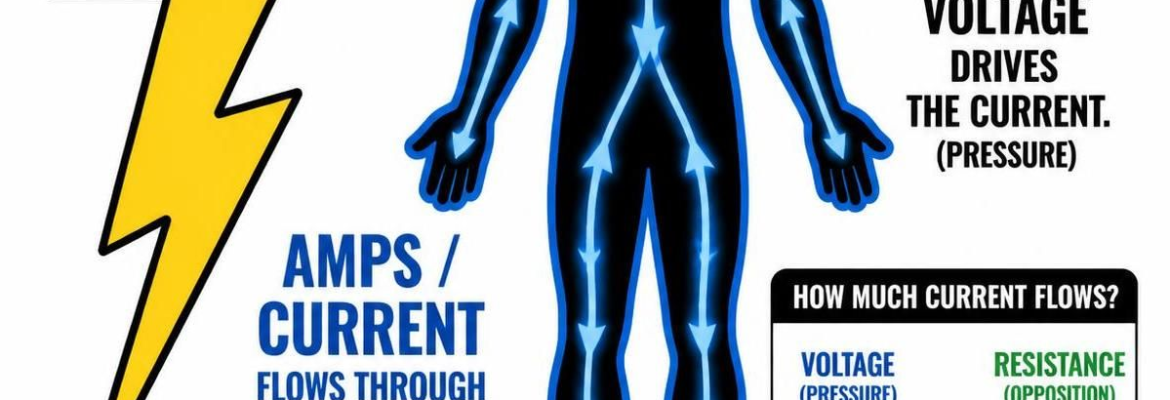
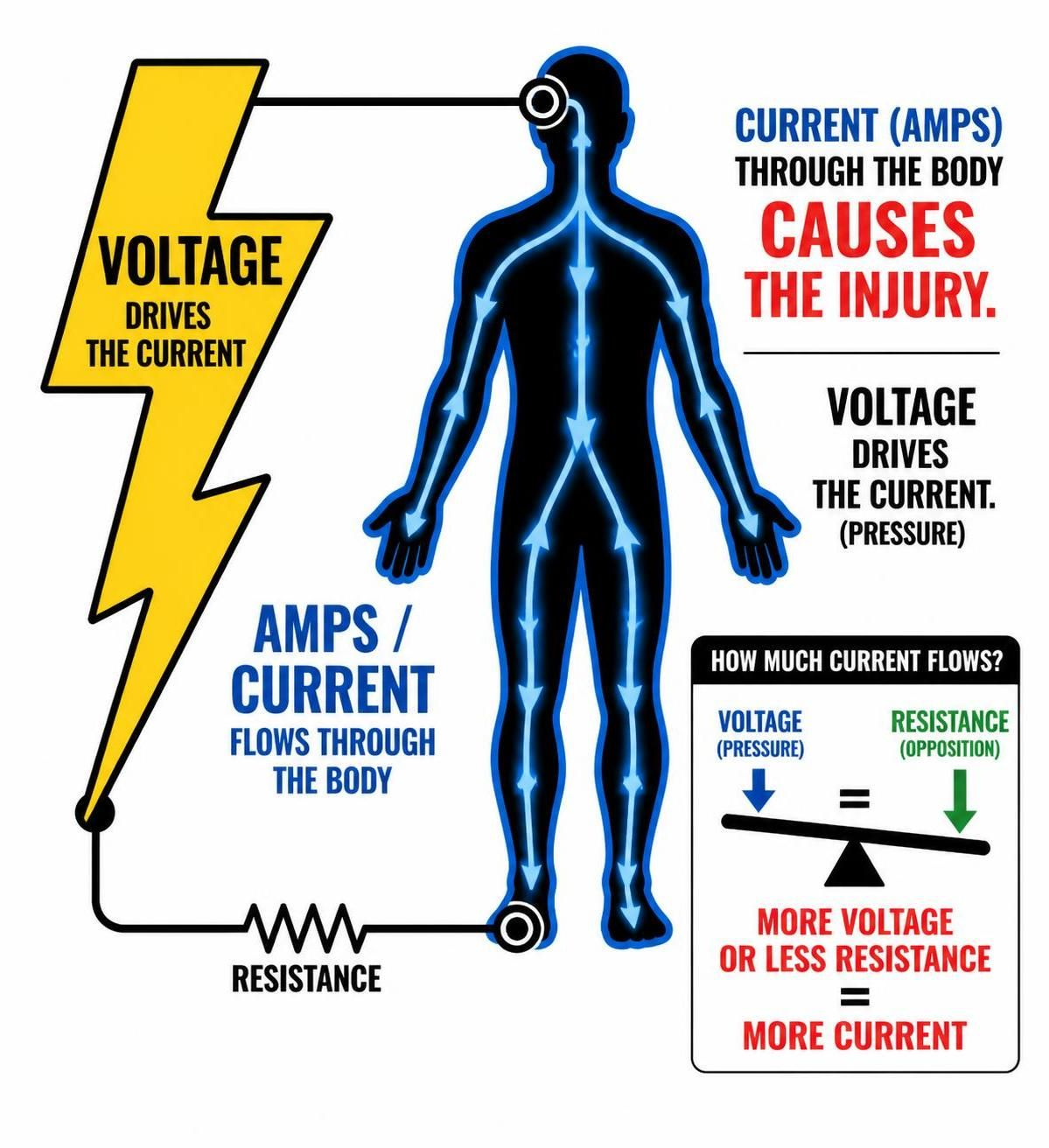
Electrical current (amps) flowing through the body is what directly produces many of the harmful physiological effects. However, voltage is what drives that current through the body. Therefore, both voltage and current are important when assessing electrical danger.
This distinction is particularly important for anyone working with electrical, HVAC, refrigeration, solar and industrial equipment.
Educational only. Amps cause damage, Volts drive them. RCD at 30mA saves life. Never touch live wires.
What Is Voltage?
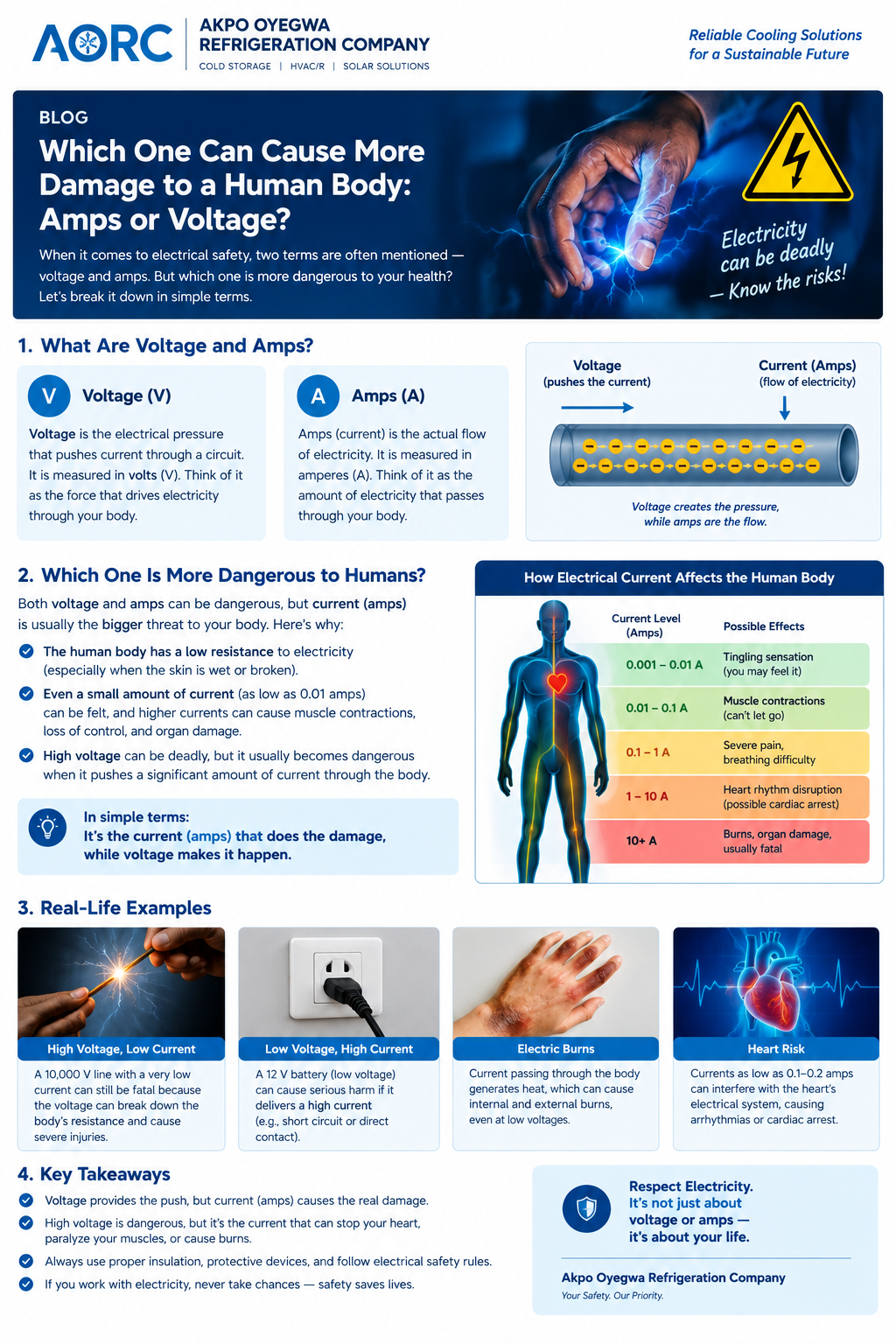
Voltage (V) is the electrical potential difference between two points. It can be thought of as the electrical pressure that drives current through a circuit.
Voltage is measured in volts (V).
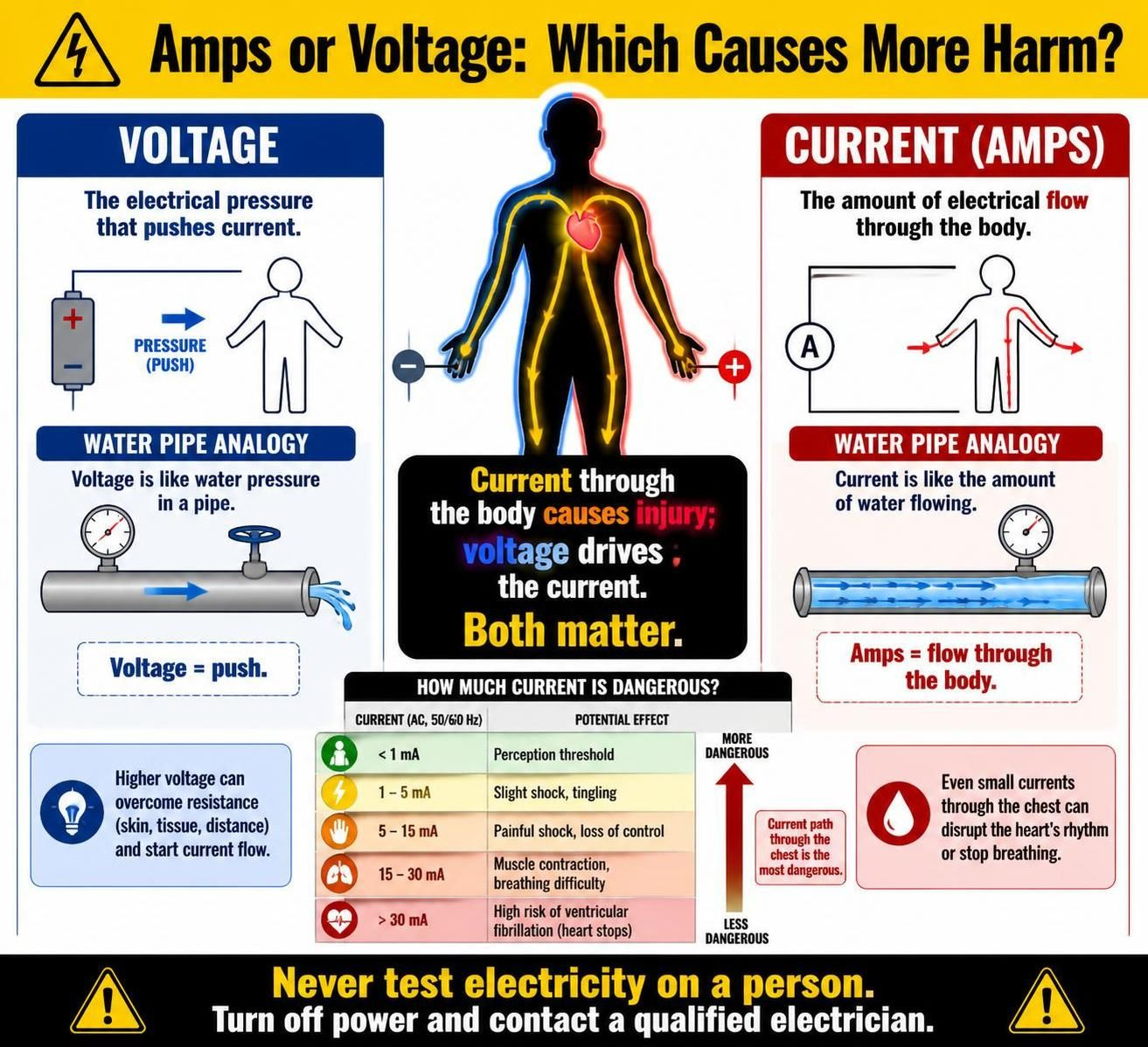
A useful analogy is a water pipe:
Voltage = water pressure
Current = amount of water flowing
Resistance = restriction in the pipe
A higher voltage can create a greater potential for current to flow through the human body, depending on the body’s resistance and the conditions of contact.
Simple electrical diagram
Voltage → drives → Current → through → Resistance
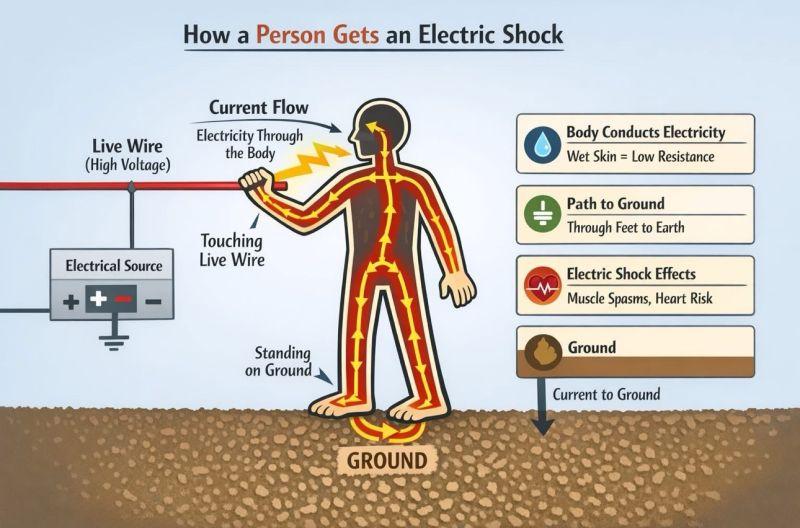
For the human body:
Electrical voltage → pushes current through the body → biological effects
What Are Amps?
Amperage, commonly called amps (A), is the amount of electrical current flowing through a circuit.
Current is measured in amperes (A).
Unlike voltage, which represents the electrical potential that drives the current, amperage describes the actual flow of electric charge.
This distinction is important because it is the current flowing through the body that can interfere with nerves, muscles, breathing and the heart.
Voltage vs Amps: The Relationship
Voltage and current are closely connected by Ohm’s Law:
V = I × R
Where:
V = Voltage (volts)
I = Current (amps)
R = Resistance (ohms)
Rearranging the equation:
I = V ÷ R
This means that the amount of current passing through a person’s body depends on both the applied voltage and the body’s electrical resistance.
For example, if the resistance decreases while voltage remains the same, the current can increase.
This is one reason electrical contact becomes particularly dangerous when the skin is wet, damaged or otherwise provides less resistance.
Which One Causes More Damage: Amps or Voltage?
The most technically accurate answer is that current through the body is the immediate cause of electrical injury, while voltage provides the driving force that produces that current.
In other words:
Voltage pushes. Current flows. Current causes the physiological effects.
Electrical current can:
Stimulate nerves
Cause involuntary muscle contractions
Prevent a person from releasing an energized conductor
Interfere with the heart’s electrical activity
Interfere with breathing
Produce burns
Cause internal tissue damage
However, it would be misleading to say that voltage does not matter.
A sufficiently high voltage can drive dangerous current through the body, particularly when body resistance is low.
Therefore, electrical safety should never be based on amperage alone.
How Much Current Can Be Dangerous?
There is no single current value that guarantees a particular injury.
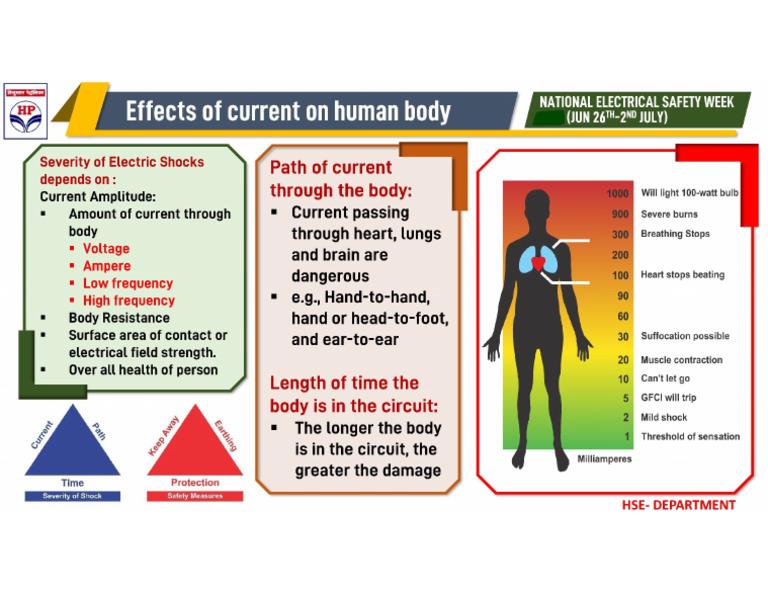
The effect of an electrical shock depends on several factors, including:
Current magnitude
Voltage
Duration of contact
Current path through the body
Frequency
Skin condition
Body resistance
Whether the person is wet
The electrical source and available fault current
For example, current passing from one hand to the other can cross the chest and potentially affect the heart.
The duration of exposure is also extremely important. A relatively small current sustained for longer can be more dangerous than a brief exposure.
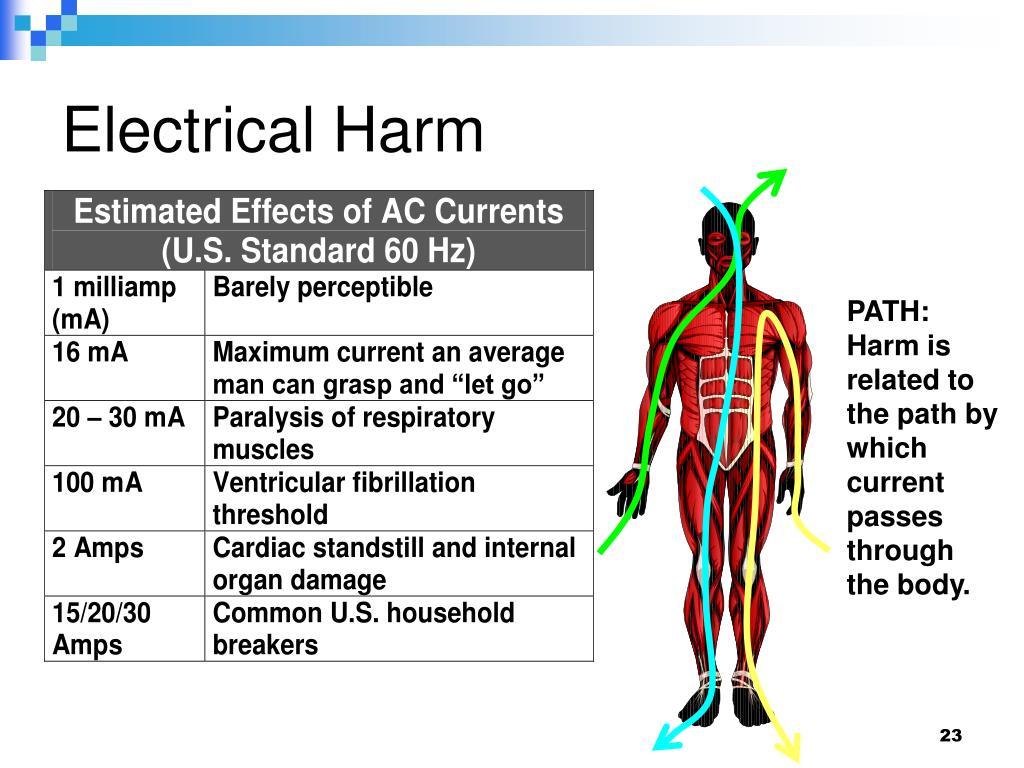
Approximate effects of 50/60 Hz AC current
The following values are approximate ranges, not guaranteed injury thresholds:
Current through the body
Possible effect
Around 1 mA
Perception/tingling may occur
Several mA
Increasing discomfort and muscle stimulation
Around 10–20 mA
Strong muscle contraction; release may become difficult
Around 20–30 mA and above
Increasing respiratory and muscular risk
Around 50–100 mA
Serious cardiac effects can occur
Higher currents
Severe burns, cardiac arrest and other life-threatening injuries become increasingly possible
These figures should not be interpreted as safe operating limits. Individual responses vary considerably.
Why Can a Small Current Be Dangerous?
The human heart depends on precisely coordinated electrical signals.
An external electrical current passing through the body can interfere with that electrical activity.
Depending on the circumstances, this can result in abnormal heart rhythms, including potentially fatal arrhythmias.
Current can also cause involuntary muscle contraction.
This can create a particularly dangerous situation where a person is unable to release an energized conductor.
Does High Voltage Always Mean Instant Death?
No.
Voltage alone does not determine the outcome of an electrical contact.
A high-voltage source can certainly be extremely dangerous, but the injury produced depends on factors such as:
How much current actually passes through the body
How long the contact lasts
The current’s path
The characteristics of the electrical source
Body resistance
Environmental conditions
Conversely, relatively low-voltage systems can also cause serious injury under unfavorable conditions.
For this reason, electrical workers should treat all energized equipment with appropriate caution rather than assuming that a particular voltage is automatically harmless.
Can Low Voltage Cause Serious Injury?
Yes.
Low-voltage electrical systems can cause dangerous shocks, particularly when conditions allow significant current to pass through the body.
For example, a low-voltage battery may be capable of delivering very high current under fault or short-circuit conditions.
However, whether that current can actually pass through a person’s body depends on the electrical circuit and the body’s resistance.
This is why the statement “low voltage means safe” is not a reliable electrical-safety rule.
What Happens When Electricity Passes Through the Human Body?
Electrical current can affect different parts of the body depending on its path.
1. Nervous system
Electric current can interfere with the normal operation of nerves and cause pain, abnormal sensations or involuntary reactions.
2. Muscles
Electrical stimulation can cause involuntary muscle contraction.
In some circumstances, this can make it difficult for a person to release an energized conductor.
3. Heart
Current passing through the chest can interfere with the heart’s electrical system and potentially cause life-threatening cardiac arrhythmias.
4. Respiratory system
Strong electrical stimulation can interfere with the muscles involved in breathing.
5. Skin and tissue
Electrical energy can produce burns at the points of contact and, depending on the circumstances, deeper tissue damage.
The Importance of Current Path
The path electricity takes through the body is extremely important.
For example:
Hand → Arm → Chest → Arm → Hand
can create a current path through the chest.
A current path involving the chest is particularly concerning because the heart and respiratory system may be affected.
This is one reason electrical workers are trained to avoid creating a path between energized conductors and ground or between different electrical potentials.
What Makes Electrical Shock More Dangerous?
Wet skin
Water can significantly change the electrical resistance of the skin.
Wet conditions can therefore increase the amount of current that may flow through the body.
Broken or damaged skin
Damaged skin can provide less resistance than intact dry skin.
Longer contact
The longer current continues flowing through the body, the greater the potential for injury.
Current through the chest
A current path through the chest can create a serious risk to the heart and respiratory system.
High available fault current
Electrical systems capable of delivering large currents can produce severe arc-flash, burn and shock hazards.
Voltage Is Not the Same as Available Current
Another important distinction is between voltage and the amount of current an electrical source is capable of supplying.
A power supply may have a particular voltage rating while being designed to deliver only a limited amount of current.
Another source may have a similar voltage but be capable of supplying a much larger fault current.
This is particularly important when dealing with:
Batteries
Solar installations
Inverters
Generators
Distribution boards
Industrial electrical systems
HVAC equipment
Refrigeration equipment
Electrical hazards must therefore be evaluated based on the complete system rather than a single number.
Why Electrical Safety Is Important in HVAC and Refrigeration
HVAC and refrigeration systems frequently contain electrical components capable of presenting serious hazards.
Depending on the installation, technicians may work around:
Compressors
Motors
Capacitors
Contactors
Inverters
Control panels
Variable-frequency drives
Generators
Solar PV systems
Battery energy-storage systems
High-current cables
Refrigeration control systems
A refrigeration system may therefore involve both electrical hazards and refrigeration hazards.
Before servicing electrical equipment, appropriate procedures such as isolation, lockout/tagout, verification of de-energization and the use of suitable personal protective equipment should be followed according to applicable safety procedures and regulations.
A Simple Way to Remember It
Think about electricity using this simple relationship:
Voltage = the push
Amps = the flow
Resistance = the opposition to the flow
Electrical injury = depends substantially on the current flowing through the body, together with exposure time, pathway and other conditions
Therefore:
Voltage creates the potential for current to flow, while current flowing through the body produces the direct physiological effects associated with electrical shock.
Common Misconceptions About Electricity
Myth 1: “Voltage is harmless; only amps kill.”
Incorrect.
Voltage is a critical part of the hazard because it provides the potential that drives current through the body.
Myth 2: “Anything below a certain voltage is completely safe.”
Incorrect.
There is no universal voltage value that makes every situation safe. The source, environment, contact conditions and circuit characteristics all matter.
Myth 3: “A high-voltage system always produces more current through a person.”
Incorrect.
The actual current through the body depends on the electrical circuit, body resistance and contact conditions.
Myth 4: “If an electrical device is switched off, it is automatically safe to touch.”
Not necessarily.
Some equipment can retain electrical energy after being switched off, particularly equipment containing capacitors or energy-storage systems.
Proper isolation and verification are essential before working on electrical equipment.
Key Takeaways
Voltage is electrical potential difference.
Amperage is the amount of current flowing.
Voltage provides the driving force that can push current through the body.
Current flowing through the body produces many of the direct physiological effects of electric shock.
The danger depends on more than voltage or amperage alone.
Current path, exposure duration, body resistance and environmental conditions are extremely important.
Wet conditions can increase electrical shock risk.
Both low-voltage and high-voltage systems can present serious hazards.
Never use a voltage or amperage number as a substitute for proper electrical safety procedures.
Electrical work should be performed only by appropriately trained and qualified personnel using suitable safety procedures and equipment.
Final Answer: Amps or Voltage?
If the question is “Which one directly causes the damage to the human body?”, the answer is generally electrical current (amps).
If the question is “Which one determines whether dangerous current can flow?”, then voltage is critically important.
The safest way to understand the relationship is:
Voltage drives the current, and current flowing through the body can cause the injury.
For electrical, HVAC, refrigeration and solar professionals, the correct approach is therefore not to ask whether voltage or amperage is dangerous in isolation, but to assess the entire electrical hazard.
Electricity should always be treated with respect. Proper isolation, qualified personnel and appropriate safety procedures can help prevent electrical injuries and save lives.