kVA vs kW: Why Your Solar Installer Mentions Both (and Which One You Actually Pay For)
If you’ve ever shopped for a solar power system, an inverter, or a generator, you’ve seen two ratings that look almost identical: kVA and kW. They’re both units of electrical power. They both have “kilo” in front. So why do engineers insist they’re completely different and why does getting them wrong cost you money?
The short answer: kW (kilowatt) is the power that actually does useful work, while kVA (kilovolt-ampere) is the total power an electrical system must handle. The gap between them is called power factor and it’s the single most misunderstood concept in solar and electrical system design.
In this guide, we’ll break down the difference between kVA and kW with diagrams, real solar examples, and the simple math you need to size your system correctly.
What Is kW? (Real Power — The Power You Use)
A kilowatt (kW) measures real power the actual energy converted into useful work: spinning a motor, heating water, lighting a bulb, or charging your phone. When your electricity bill says you consumed 500 kWh last month, that “kWh” is kilowatts × hours. You pay for kW, not kVA.
A 5 kW solar array can deliver 5,000 watts of usable power under standard test conditions.
A 2 kW kettle converts 2,000 watts of electrical energy into heat.
Your utility meter measures real power (kW) accumulated over time (kWh).
What Is kVA? (Apparent Power — The Power Your Equipment Must Supply)
A kilovolt-ampere (kVA) measures apparent power the total “load” flowing through wires, transformers, and inverters. It combines real power (kW) with reactive power (kVAR), which magnetizes motors, transformers, and inductors without doing useful work.
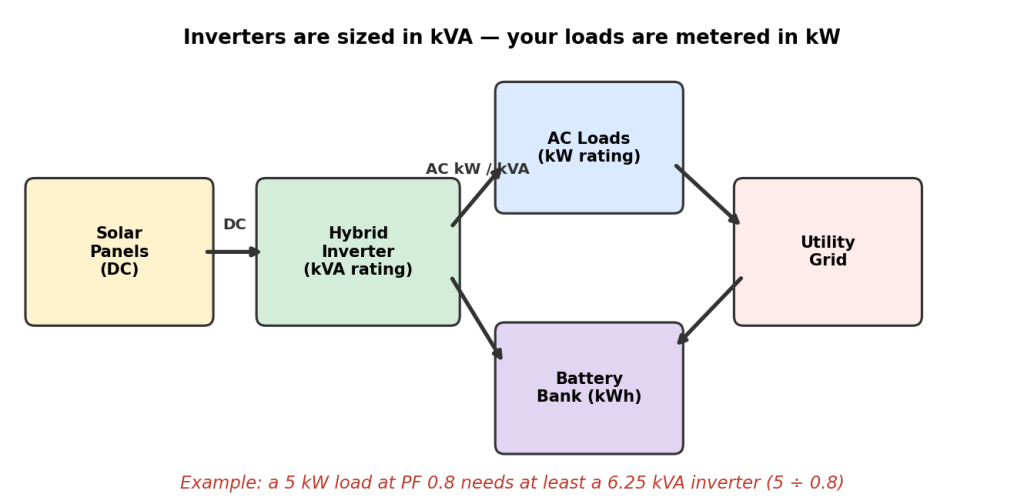
Here’s the crucial part: inverters, generators, and transformers are sized in kVA, because their internal components must handle the total current including the reactive portion. This is why a “5 kVA inverter” doesn’t always deliver 5 kW of usable power.
The Power Triangle: The Relationship Explained Visually
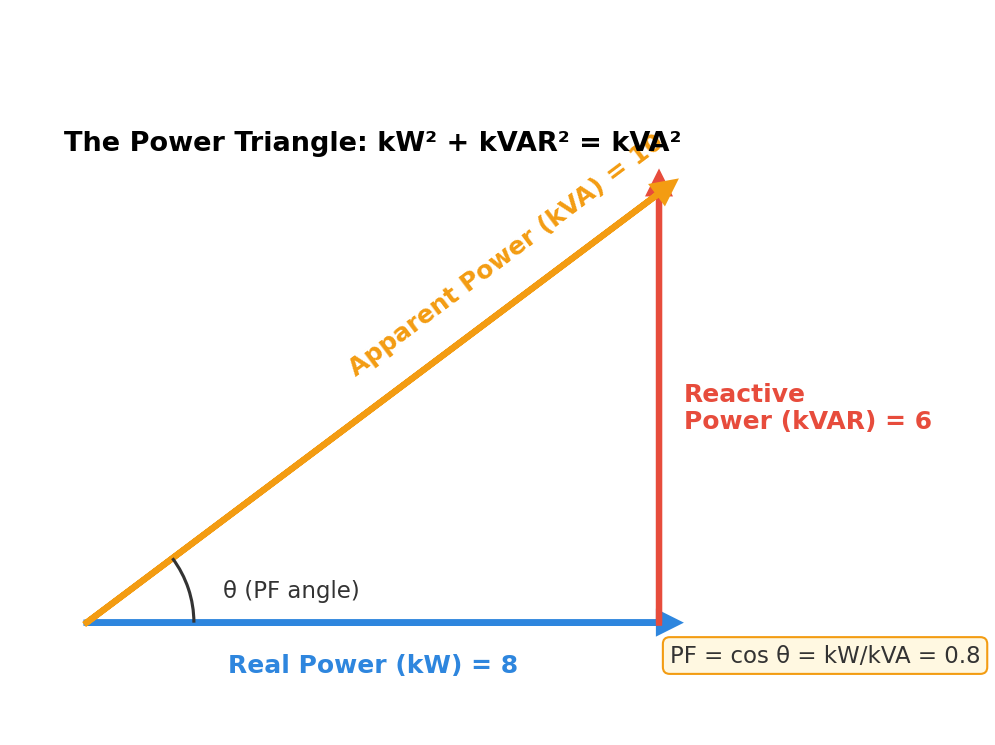
kW, kVAR, and kVA form a right-angled triangle. Once you see it, the relationship becomes unforgettable:
The power triangle: kW² + kVAR² = kVA². Power factor is simply cos θ.
The math is simple:
kVA² = kW² + kVAR²
kW = kVA × Power Factor (PF)
kVA = kW ÷ Power Factor
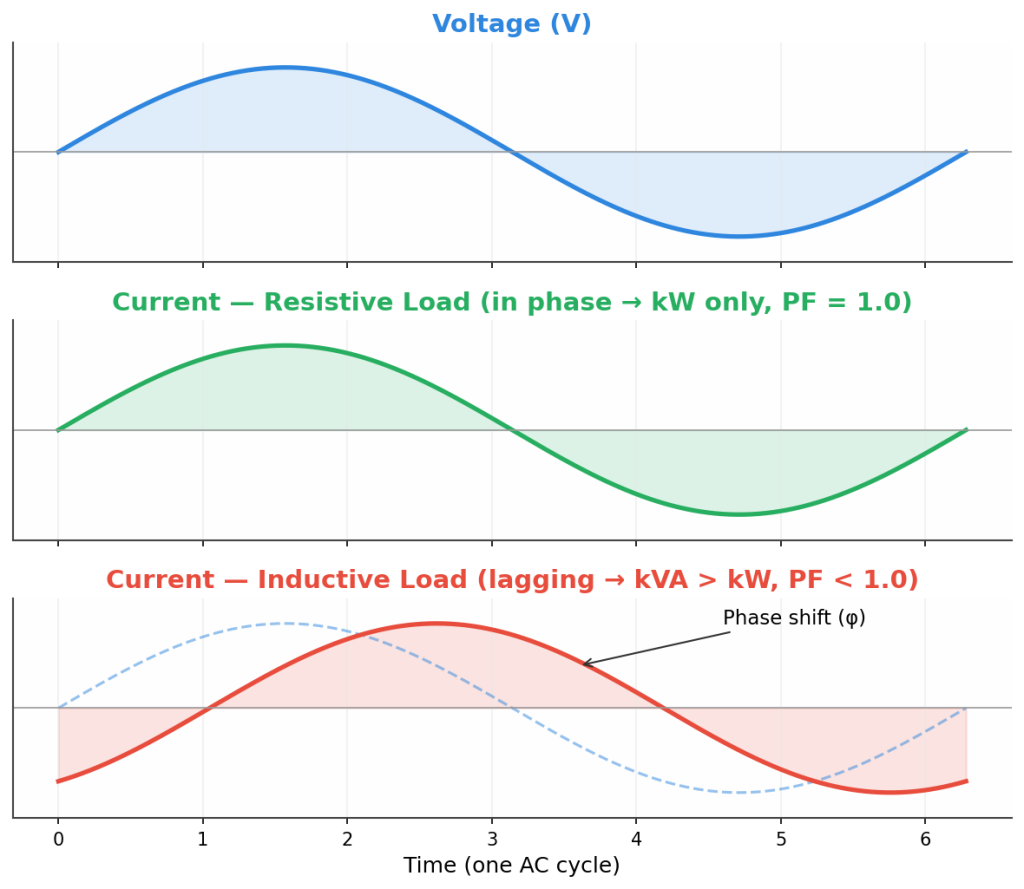
Power factor ranges from 0 to 1. At PF = 1.0 (purely resistive load like a heater or incandescent bulb), kVA equals kW no wasted capacity. Most real-world loads motors, pumps, compressors, fluorescent lighting run at 0.7–0.9 PF, meaning your equipment supplies more kVA than the kW you actually use.
Left: resistive load, current in phase with voltage (PF = 1). Right: inductive load, current lags voltage (PF < 1, creating reactive power).
This phase shift creates reactive power (kVAR) — energy that sloshes back and forth between the source and the load without being consumed. It does no useful work, but it heats cables, stresses equipment, and occupies capacity in your inverter.
The Beer Mug Analogy (The Easiest Way to Remember kVA vs kW)
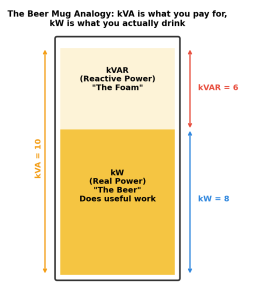
Picture a mug of beer:
kW is the beer (useful), kVAR is the foam (useless but takes up space), kVA is the whole mug.
🍺 The beer = kW — the part you actually wanted.
🫧 The foam = kVAR — useless, but it fills the mug and you paid for it anyway.
🍺 The entire mug = kVA — the total capacity the glass (your inverter/generator) must provide.
You can’t pour beer without some foam. Likewise, you can’t deliver kW without supplying kVA.
Why This Matters for Your Solar Power System
This is where kVA vs kW stops being theory and becomes money:
Inverters are rated in kVA, but your loads consume kW. Power factor determines how much kW a given kVA rating can actually deliver.
Sizing your inverter (the most common mistake)
Suppose your home needs 5 kW of real power and your loads have a power factor of 0.8:
Required kVA = 5 kW ÷ 0.8 = 6.25 kVA
A 5 kVA inverter would overload — it can only deliver 5 × 0.8 = 4 kW
You actually need a 6.25 kVA (or 7+ kVA) inverter to run 5 kW of loads safely
Marketing often blurs this line. A “5 kVA hybrid inverter” with a typical PF of 0.8 delivers only 4 kW continuous a 20% difference that surprises many buyers.
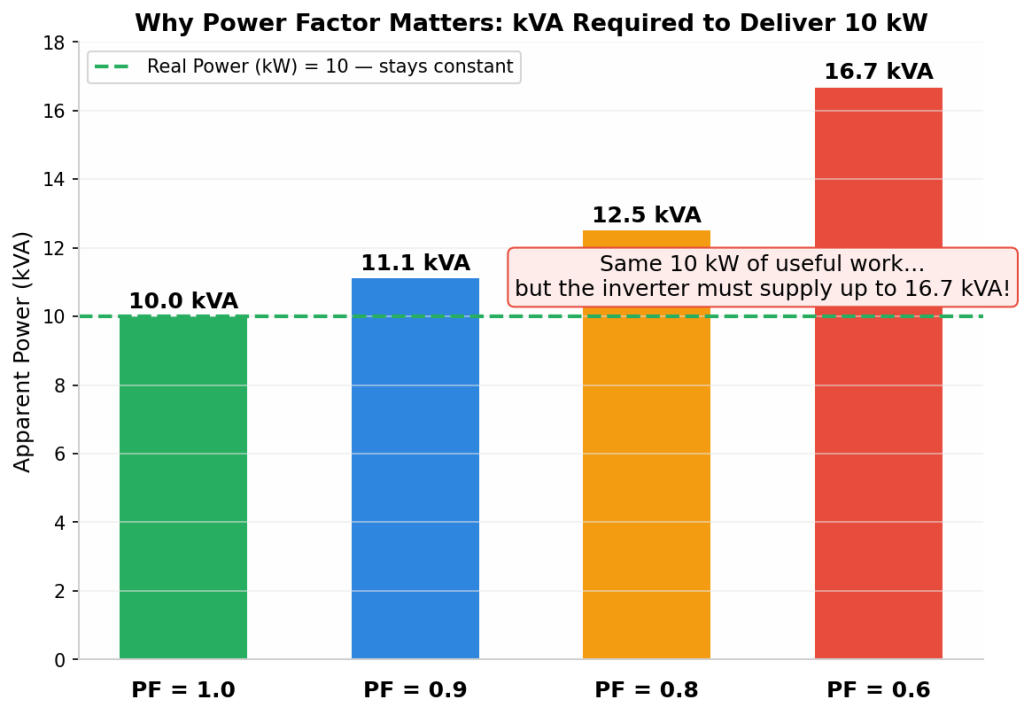
How power factor changes everything
To deliver the same 10 kW, a system at PF 0.6 must handle 16.7 kVA — 67% more capacity than at PF 1.0.
The lower your power factor, the more oversized (and expensive) your inverter, generator, and cabling must be for the same useful output. This is why industrial facilities are penalized for poor PF and why modern solar inverters include reactive power compensation to push PF closer to 1.0.
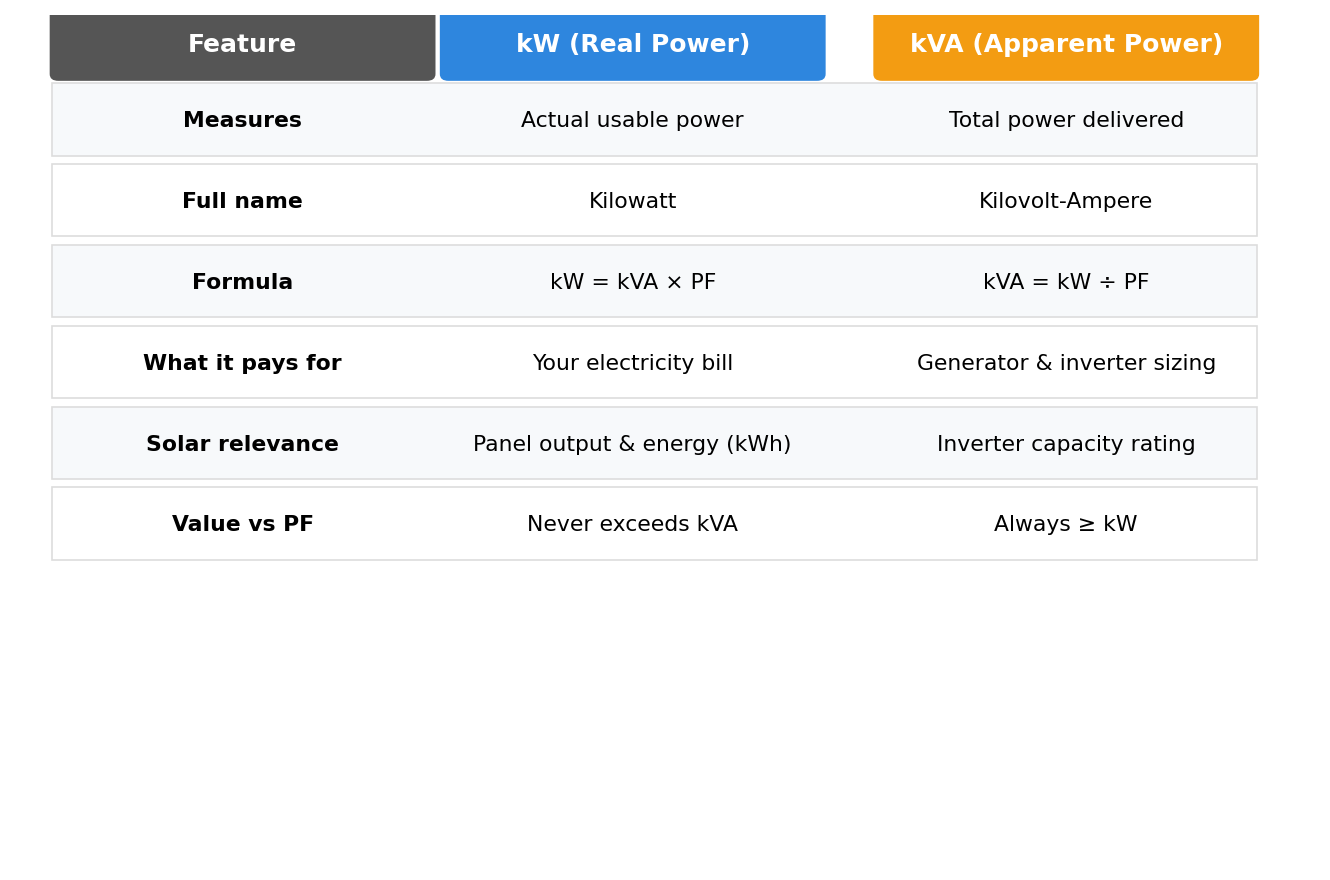
kVA vs kW: Side-by-Side Comparison
To summarize the key differences:
Feature
kW
kVA
Type of power
Real power
Apparent power
What it represents
Work actually performed
Total power the system must carry
Who uses it
Utility billing, solar panel output
Inverter, generator & transformer ratings
Relationship
kW = kVA × PF
kVA = kW ÷ PF
Similarities Between kVA and kW
Despite the differences, kVA and kW share important traits which is exactly why they’re so often confused:
Both measure power. Both quantify the rate of energy transfer, just from different perspectives (useful vs total).
Both are scaled in kilo (×1,000). 1 kVA = 1,000 VA; 1 kW = 1,000 W.
Both apply to AC circuits. In pure DC circuits, power factor is always 1, so kVA and kW are identical.
They’re linked by one formula. Knowing any two of kVA, kW, and PF instantly gives you the third.
Both matter in solar design. kW sizes your panels and predicts energy production (kWh); kVA sizes your inverter and wiring.
Practical Takeaways for Homeowners and Solar Buyers
✅ Compare inverters by their kW output at rated PF, not just the headline kVA number.
✅ When sizing a system, list your loads in kW, then divide by expected PF (0.8 is a safe default) to get required kVA.
✅ Add 20–25% headroom above your calculated kVA for surge loads (fridges, pumps, AC compressors draw 3–7× their rating at startup).
✅ Consider a hybrid inverter with power factor correction if your loads are motor-heavy.
✅ Remember: your panels produce kW; your inverter handles kVA; your bill charges kWh.
The Bottom Line
kW and kVA aren’t competing units they’re two views of the same electrical reality. kW is what you use; kVA is what your equipment must endure. The bridge between them, power factor, is what separates a well-designed solar system from an undersized, overloaded one. Next time an installer quotes you a “10 kVA system,” you’ll know exactly to ask: “And how many kW is that at power factor 0.8?”
Frequently Asked Questions
Is 1 kVA equal to 1 kW?
Only when power factor equals 1.0 (purely resistive load). At PF 0.8, 1 kVA = 0.8 kW.
Which is bigger, kVA or kW?
kVA is always equal to or greater than kW, because it includes reactive power on top of real power.
Why are generators rated in kVA and not kW?
Because a generator’s windings and core must carry the total current (apparent power), regardless of how much of it becomes useful work.
What is a good power factor for a home?
Above 0.9 is considered good. Below 0.85, utilities may apply PF penalties on commercial accounts, and your inverter is working harder than necessary.